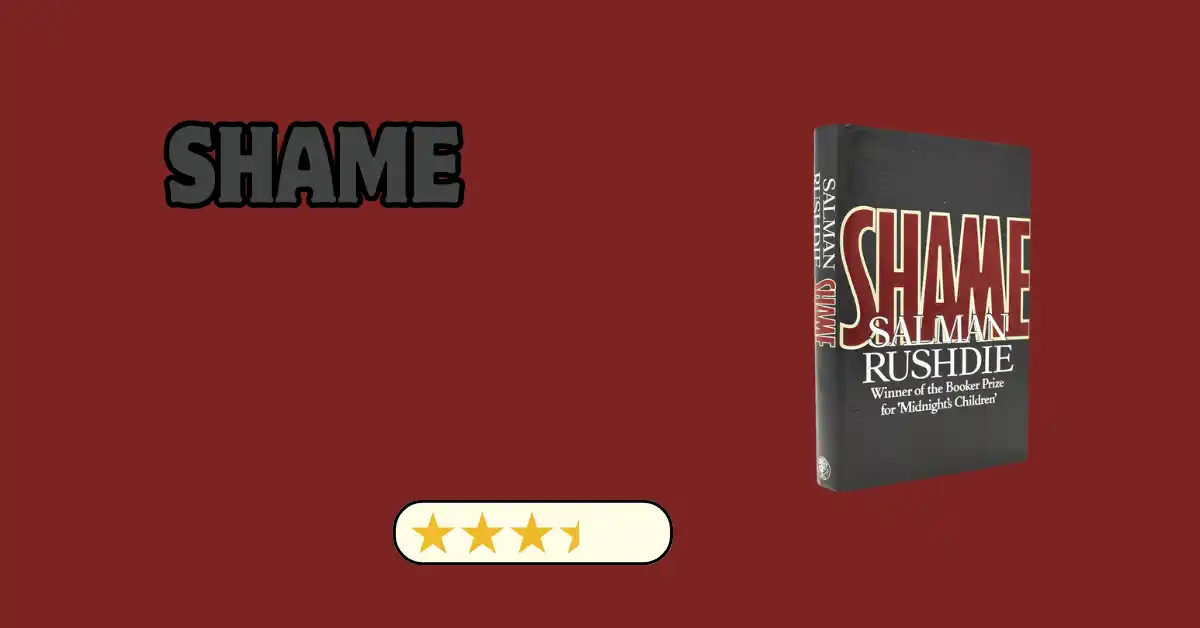
Shame by Salman Rushdie
I need to say this upfront. Magical realism is not the kind of writing I usually pick up. I like my stories a little more grounded, a little less slippery. But Shame worked for me in ways I did not expect. Not all the way through, and not without resistance, but enough to stay with me long after I turned the last page.
This is not a book that lets you relax. It does not want your comfort. It wants your attention, your discomfort, and maybe even your anger.
What the Book Is About
Shame takes place in a country that Salman Rushdie refuses to name but clearly resembles Pakistan. The time is somewhere around the 1970s and 1980s, when military rule, political corruption, and violent power struggles shaped the nation. But this is not a history book. It is history twisted, stretched, and refracted through a distorting lens.
Salman Rushdie takes real events and real people and turns them into something else. He exaggerates, invents, and plays with truth until it becomes something between fiction and commentary. The result is a story that feels both familiar and alien at the same time.
The novel follows two families and the men at their centre. One is a general who rises to power through violence and cunning. The other is a populist leader who speaks to the masses but hides his own corruption. Between them, women suffer, children are scarred, and society fractures under the weight of hypocrisy.
But this is not just about Pakistan. Salman Rushdie uses the setting to explore something bigger. He explores how nations build themselves on lies. How power corrupts not just individuals but entire cultures. How shame, as an emotion and a weapon, shapes behaviour in ways that are both invisible and devastating.
The Prism of Irony
If I had to describe this book in one line, I would say it is a prism. It takes a single beam of light and splits it into colours that do not sit comfortably next to each other. Society, politics, religion, family, love, they all pass through this prism and emerge fractured, contradictory, and unsettling.
Nothing in Shame remains pure. Nothing stays stable. Every idea, every person, every emotion is undercut by something else. Honour becomes cruelty. Love becomes possession. Strength becomes fragility.
Salman Rushdie does this through tone. He mixes humour with horror. Sarcasm with tragedy. Criticism with compassion. The effect is disorienting. You laugh, then feel guilty for laughing. You judge a character, then realise you have been complicit in the same behaviour.
This is not gentle satire. It does not guide you towards clarity. It stains you. It leaves marks.
Salman Rushdie uses irony and satire to critique society with a very different kind of humour. Its with a sense that pokes at absurdity without the same weight of political violence.
The Constant Flip
One of the most striking things about Shame is how it refuses to let anything settle. Every binary gets flipped. Every certainty gets questioned.
The strong are revealed to be weak. The beautiful become monstrous. Victims become victimisers. Shame and shamelessness swap places so often that you stop knowing which is which.
Take the female characters. Many of them begin as victims of male violence, male ambition, male ego. But Salman Rushdie does not leave them there. He shows how some of them wield their own forms of cruelty. How they betray, manipulate, and destroy in their own ways.
This does not excuse the men. But it complicates the narrative. It refuses the comfort of clear villains and clear heroes.
The same goes for shame itself. In some moments, shame is what keeps people human. It is the internal voice that says, this is wrong. But in other moments, shame becomes a cage. It silences women. It justifies violence. It creates monsters out of people who have been humiliated too many times.
Every coin in this book has two sides, and neither is clean.
Society Under the Lens
Salman Rushdie takes apart almost every pillar of society in this novel.
Marriage is shown as a transaction, often loveless, often violent. Women are traded, controlled, and discarded. But even within that system, some women find ways to resist, to manipulate, to survive.
Family is not a safe space. It is where shame is learned, where power is first exercised, where betrayal begins. Parents damage their children. Siblings compete and wound each other. Love, when it appears, is usually tangled with possession or guilt.
Religion is used as a tool. It justifies cruelty, enforces rules, and silences dissent. But it also provides meaning for some, even if that meaning is built on hypocrisy.
Politics is theatre. The military leader pretends to be strong but is terrified of losing control. The populist leader pretends to care about the people but enriches himself. Both are trapped in their own performances.
None of these institutions are treated as sacred. Salman Rushdie does not spare anything or anyone.
The Ambiguity That Stays
One of the hardest things about reading Shame is that it does not give you moral certainty. It does not tell you who to root for. It does not offer redemption or hope.
The characters are flawed in ways that feel both tragic and infuriating. You understand why they do what they do, but that does not make it okay. The betrayed also betray. The powerless, when given power, often become cruel.
Even the victims are not entirely innocent. Even the villains are not entirely monstrous.
This is uncomfortable. It forces you to sit with contradictions. It refuses the easy answers.
How It Reads
Shame is not an easy read. The writing is dense, layered, and at times deliberately confusing. Salman Rushdie interrupts his own story. He steps in as the narrator and talks directly to the reader. He admits he is making things up. He questions his own choices.
This meta approach can feel jarring. Just when you get absorbed in the story, Salman Rushdie pulls you out and reminds you that this is fiction, that he is constructing something, that nothing here is neutral.
The language itself is rich but not always accessible. Salman Rushdie uses long sentences, symbolic imagery, and cultural references that may not be familiar to every reader. You have to slow down. You have to reread passages. You have to sit with confusion for a while before things start to make sense.
Some readers will find this frustrating. Others will find it rewarding. I found it both.
The pacing is uneven. Some sections drag. Others rush past important moments. The structure is fragmented. The timeline jumps. The focus shifts.
But all of this feels intentional. The disorientation is part of the design. The book is trying to capture the chaos, the instability, the moral confusion of the world it portrays.
The Experience of Reading
Shame is not the kind of book that sweeps you away. It does not offer escape. It offers reflection, resistance, and residue.
I read it slowly. I put it down more than once. I argued with it in my head. I disagreed with choices Rushdie made. I got frustrated with the detours, the interruptions, the refusal to resolve anything cleanly.
But I also found myself thinking about it when I was not reading it. Lines would come back to me. Images would linger. Questions would surface days later.
This is a book that leaves marks. It does not offer closure. It does not tie things up neatly. It lingers.
Is This Book for You
If you like stories that are clear, linear, and emotionally comforting, Shame is not for you. If you want heroes to root for and villains to hate, this is not the right book.
But if you appreciate political allegory, if you are open to contradiction, if you are willing to sit with discomfort, then Shame has something to offer.
It is best for readers who do not need moral certainty. Who can handle ambiguity. Who are okay with being challenged, unsettled, and left without answers.
It is also a good fit for readers interested in postcolonial literature, magical realism, or political fiction. For those curious about how novels can function as critique, as protest, as a way of speaking truth through distortion.
If you read slowly, if you are patient with difficult prose, if you like books that demand something from you, then this is worth your time.
Why It Still Matters
Shame was published in 1983, but it does not feel dated. The political dynamics it explores, the use of shame to control behaviour, the fragility of power, the hypocrisy of leaders, these are still relevant.
Salman Rushdie wrote this book before the fatwa, before he became a symbol of free speech and censorship. But even then, he was taking risks. He was writing about a country that did not want to be written about this way. He was exposing things that people wanted to keep hidden.
The book was banned in Pakistan. Salman Rushdie was criticized, attacked, and eventually forced into hiding for other work. But Shame remains. It continues to be read, discussed, and debated.
It matters because it refuses to be comfortable. It matters because it does not simplify. It matters because it insists that truth is complicated, that power is always compromised, and that shame is both a weapon and a wound.
Some Questions That Might Come to Mind Before Buying This Book
Is this book difficult to read if I’m not into magical realism?
It can feel challenging, but not inaccessible. Even if magical realism isn’t your preferred genre, the political insight and moral tension can still pull you in.
Do I need to know Pakistan’s political history to understand it?
Basic awareness helps, but it isn’t essential. The novel works more as an allegory than a history lesson.
Is this a plot-driven novel or an idea-driven one?
Very much idea-driven. The plot exists, but the real weight lies in themes, contradictions, and commentary.
Is the book overtly political?
Yes, but not in a straightforward way. Politics appears through satire, symbolism, and exaggeration rather than direct argument.
Does the book take clear moral positions?
No. That’s part of its strength. Victims and perpetrators blur into each other, forcing the reader to sit with discomfort.
Will this book make me feel unsettled?
Likely. The novel is designed to disturb easy binaries like good and evil, shame and shamelessness.
Who will enjoy this book most?
Readers who enjoy layered, challenging literature that questions society, power, and identity.
Final Thoughts
I came to Shame with hesitation. Magical realism is not my natural terrain. But the book pulled me in, not because it was easy, but because it was honest in its contradictions.
Salman Rushdie does not offer answers. He does not heal anything. He holds up a mirror, and the reflection is distorted, fractured, and deeply unsettling.
Some parts of the book frustrated me. Some sections felt unnecessarily dense. Some narrative choices seemed more about showing off than serving the story.
But even with all that, Shame stays with me. It challenges the idea that fiction should comfort. It insists that literature can be uncomfortable, confrontational, and still valuable.
If you are looking for a book that will soothe you, look elsewhere. But if you want a book that will stain you, that will make you think, that will refuse to let you settle into easy judgments, then Shame is worth the effort.
It is not a book I loved. But it is a book I respect. And in some ways, that matters more.
If you’re willing to sit with contradiction, irony, and moral unease, Shame is a demanding but rewarding read.
Affiliate link. I may earn a small commission at no extra cost to you.