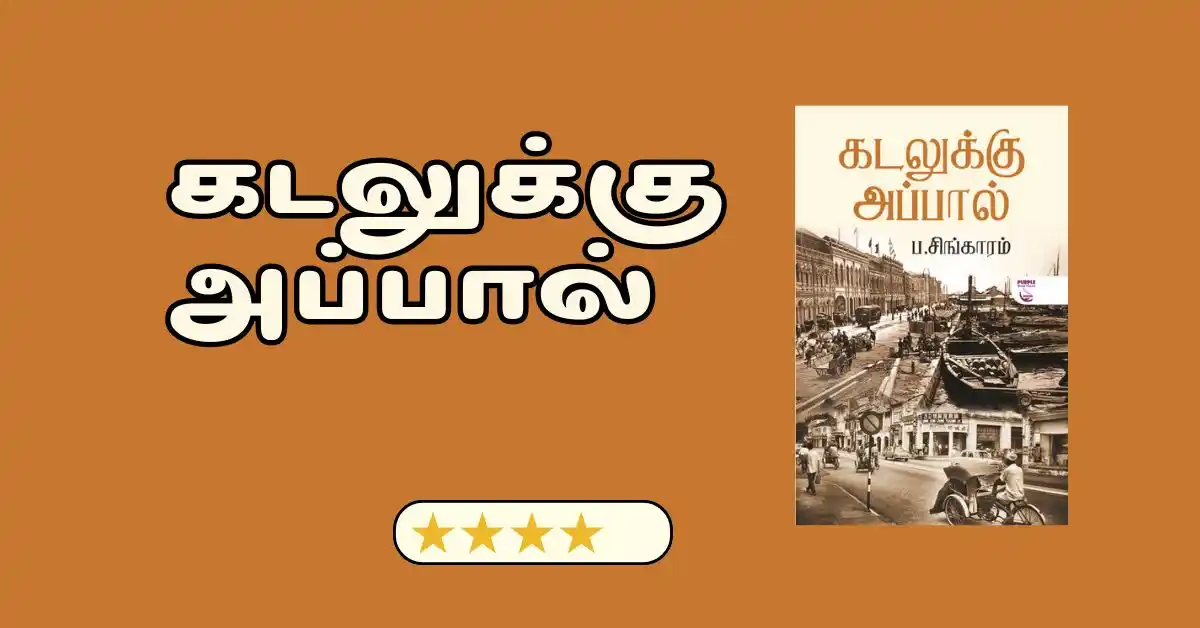
Kadalukku Appal Review
Kadalukku Appal, which loosely translates to “Beyond the Sea,” is a Tamil novel written by Pa. Singaram. Though it was originally written in the 1950s, the book now reads like a work of historical fiction that was made for this moment. It takes us into a world that most Tamil readers have never seen in their own language, which is the Tamil diaspora living in Malaya during the Second World War.
The story is set against the Japanese occupation of Malaya and touches on the Indian National Army, the force that fought under Subhas Chandra Bose with the hope of driving the British out of India. But this is not a war novel in the way most people think of one. There are no long battle scenes. There is no glorified violence. What you get instead is a quiet, careful look at the people who were caught in the middle of a very large and very brutal moment in history.
This book belongs to a small and precious group of Tamil works that step outside the Indian subcontinent and look at what happened to Tamil people who crossed the sea, built lives in other lands, and were then pulled into a war they did not start.
Why This Book Feels So Rare
Most people think of World War Two as a European story. The battles in France, the bombing of London, the fall of Berlin. Even in Indian history, the war is usually discussed through the lens of what happened on Indian soil or what the British expected from Indian soldiers.
Kadalukku Appal does something different. It takes us to Malaya, to the streets of Penang, to a world where Tamil people had been living for generations as traders, workers, and community leaders. These are not soldiers arriving from India. These are people who had already made Malaya their home. And suddenly, the Japanese are here, the British are retreating, and everyone has to decide what they stand for.
This angle, the Southeast Asian theatre of the war seen through Tamil eyes, is almost impossible to find. That alone makes this book worth reading.
The Tamil World in Penang
One of the most absorbing parts of this book is how it shows the Tamil community in Penang before the war changes everything. Pa. Singaram gives us a clear picture of the social structures, the trade networks, and the daily life of this community.
The Chettiyar community, known across Southeast Asia for their banking and lending practices, appear in the novel as anchors of economic life. The Pillai community, who often worked in administrative and clerical roles under British rule, also feature prominently. These are not just background details. They are the bones of the world the novel is built on.
You see how people do business, how they speak to each other, what they value, how they treat people from other communities, and how they carry their identity with them even when they are thousands of miles from Tamil Nadu. Reading this, you understand that the Tamil diaspora in Malaya was not a loose group of migrants. It was a structured, living community with its own internal logic and its own sense of who they were.
This is what makes Kadalukku Appal more than just a war story. It is a cultural document. It records a world that no longer quite exists in the same form, and it does so from the inside.
The Language Is the Experience
If there is one thing that sets this book apart from almost anything else you might read, it is the language.
Pa. Singaram does not write in clean, standard Tamil. He writes in the Tamil that people actually spoke in Malaya. Dialects, slang, old phrases, community-specific words. And alongside this, he weaves in Malay words, Chinese words, and even some Japanese. The conversations feel like they are actually happening in a multilingual port city because that is exactly what Penang was.
What makes this bold is that the author does not stop to explain everything. There are almost no footnotes. There is no glossary at the back that you need to keep flipping to. You are simply dropped into the world and expected to find your footing. And somehow, you do.
This choice creates something that feels rare in fiction. Real immersion. You are not a tourist being guided through a culture. You are a resident trying to understand what is happening around you. The words you do not fully know still carry meaning because of the context, the tone, and the emotion around them. This is how language actually works in real life, and the novel trusts that. That kind of linguistic rootedness can anchor a story in a way nothing else can.
When the War Arrives
The Japanese occupation of Malaya changed everything for the people living there, regardless of their background. For the Tamil community, the question became more complicated because of the Indian National Army.
The INA, fighting under Subhas Chandra Bose, saw the Japanese advance as an opportunity. If the British could be pushed out of Southeast Asia and eventually out of India, then independence might finally come. Some Indians in Malaya joined or supported the INA. Others remained loyal to the British. And many simply tried to survive.
Kadalukku Appal does not take a simple side in this. It shows INA officers and their thinking, their hopes, their frustrations. It includes references to the conflict with British forces in Burma. It presents the war as a human situation with people making difficult choices under impossible pressure, not as a clean story with heroes on one side and villains on the other.
This perspective is genuinely rare. Most fiction about World War Two, whether in English or in Indian languages, does not spend much time with Indians who aligned themselves with Japanese-backed forces. Writing about it honestly, from the inside, without either condemning or glorifying, is difficult. Pa. Singaram manages it.
If you are drawn to fiction that takes an unfamiliar position on a familiar historical event, this will reward you. Stories told from the margins of history often carry truths that official accounts leave out.
The Literary Roots Running Through the Book
What lifts Kadalukku Appal beyond straightforward historical storytelling is that it is also a book that knows Tamil literature deeply and draws from it.
There are references to Silappathikaram, the great Tamil epic written by Ilango Adigal, which itself is a story about love, loss, justice, and what happens when a society fails a woman. The shadow of that text gives certain moments in the novel a weight that goes beyond the immediate plot.
There are also references to Thayumanavar, the Tamil saint-poet whose devotional writings are full of questions about life, identity, and the nature of the self. These are not decorative references. They do actual work in the novel. They connect the characters and their struggles to a much older tradition of Tamil thought, suggesting that what these people are going through in Malaya is not separate from the long story of Tamil civilization. It is part of it.
This kind of literary depth is not common in fiction that is also doing the work of historical documentation. The fact that this novel manages both is a real achievement. That blend of culture, history, and literary tradition echoes in other works that dig into Tamil life and identity.
Tamil Pride That Does Not Apologize
There are sections of this book where the Tamil pride in the voice of the narration is very strong. It is not quiet about it. It does not soften it to make it more comfortable for a general audience.
This might surprise some readers who are used to cultural identity being handled more gently in literary fiction. But in this novel, the Tamil identity of the characters is not a background detail. It is central to how they see themselves, how they relate to other communities, and why they make the choices they make.
This assertiveness gives the book a distinct energy. You always know where you are culturally. You always know that these characters belong to a specific people with a specific history and a specific way of seeing the world. That kind of conviction is actually quite rare in fiction about diaspora communities, which often treat identity as something complicated and unresolved. Here, it is complicated, but it is not uncertain.
Who Should Read This Book
Kadalukku Appal is best suited for readers who enjoy historical fiction that puts culture at the center as much as it puts plot. If you want to understand what life looked like for Tamil communities in Malaya before and during the Second World War, this is one of the very few places you can go.
It is also a good read for anyone who is curious about the Indian National Army and the Southeast Asian theatre of the war, especially if you have only ever encountered that history through English-language sources.
Readers who enjoy Tamil literature and want to see how the language can be stretched to carry dialects, foreign words, and classical references will find a great deal to appreciate here. If you are drawn to Tamil voices that take bold, unconventional approaches to storytelling, this belongs on your list.
If you are looking for fast-paced war fiction with a lot of action, this may feel too slow. The book is unhurried. It takes its time with people and places. The war is always in the background, pressing in, but the focus stays on the human world inside it.
If the multilingual texture feels like too much to navigate, that is a fair concern. But most readers who give it a proper chance find that the language pulls them in rather than pushing them away.
Questions I Actually Had While Reading This
Wait… why have I never heard of this part of WWII before
Because most books focus on Europe. This one shows what was happening in Malaya and Burma through Indian soldiers. It feels new even though it is history.
Is this more about war or about people
More about people. The war is there, but what stays with you is how the Tamil diaspora lived, worked, and survived during that time.
Will the slang and mixed languages make it hard to read
You might notice it at first. But you settle into it quickly. It actually makes the world feel real instead of explained.
Why didn’t the author translate everything
Because he expects you to experience the world, not be guided through it. It feels more natural that way.
Is this like a typical patriotic war story
Not really. It shows the INA side of things, which is more complex. People are not shown as heroes or villains in a simple way.
What surprised me the most
How casually history is handled. Big events are happening, but the writing stays grounded in daily life and trade and conversations.
Did the Tamil references feel heavy
No. They feel organic. If you know them, you enjoy them more. If you don’t, the story still works.
Is this book more important or more enjoyable
Both. It has historical value, but it is also engaging enough to keep you reading.
How the Writing Feels
Pa. Singaram writes in a way that is clear but layered. He does not over-explain. He does not hold your hand. He gives you the scene and trusts you to be present in it.
The writing moves between the personal and the historical without making either feel like an interruption of the other. A conversation between two Chettiyar merchants about money can turn, within a few lines, into something that reveals the whole political situation of the moment. A quiet domestic moment can carry the full weight of what it means to be far from home when the world is falling apart.
This kind of writing is harder to do than it looks. Most historical fiction either gets lost in the history and forgets the people, or it gets so focused on the personal that the historical context becomes wallpaper. Kadalukku Appal keeps both alive at the same time. That balance between the intimate and the epic is something that only the best historical fiction manages.
Why This Book Matters Now
Kadalukku Appal was written in the 1950s, when the events it describes were still fresh in living memory. Reading it now, you are reading something that has quietly become a historical document as well as a novel.
The Tamil community in Malaya that the book describes has changed greatly. The political world that made the INA possible is long gone. The specific mix of languages, trades, and social customs that the novel captures so carefully is something that younger generations of the Tamil diaspora may have only heard about from grandparents.
This book keeps that world alive. It gives it texture and voice and specific human faces. Pa. Singaram was writing in the 1950s with the urgency of someone who knew that this world could be forgotten. He was right to worry. And because he wrote it down, we still have it.
Kadalukku Appal is not just a story set during war. It is a rare window into a history, a people, and a linguistic world that is often left out of mainstream narratives. That is reason enough to read it. That it is also beautifully told makes it something you will not forget easily.