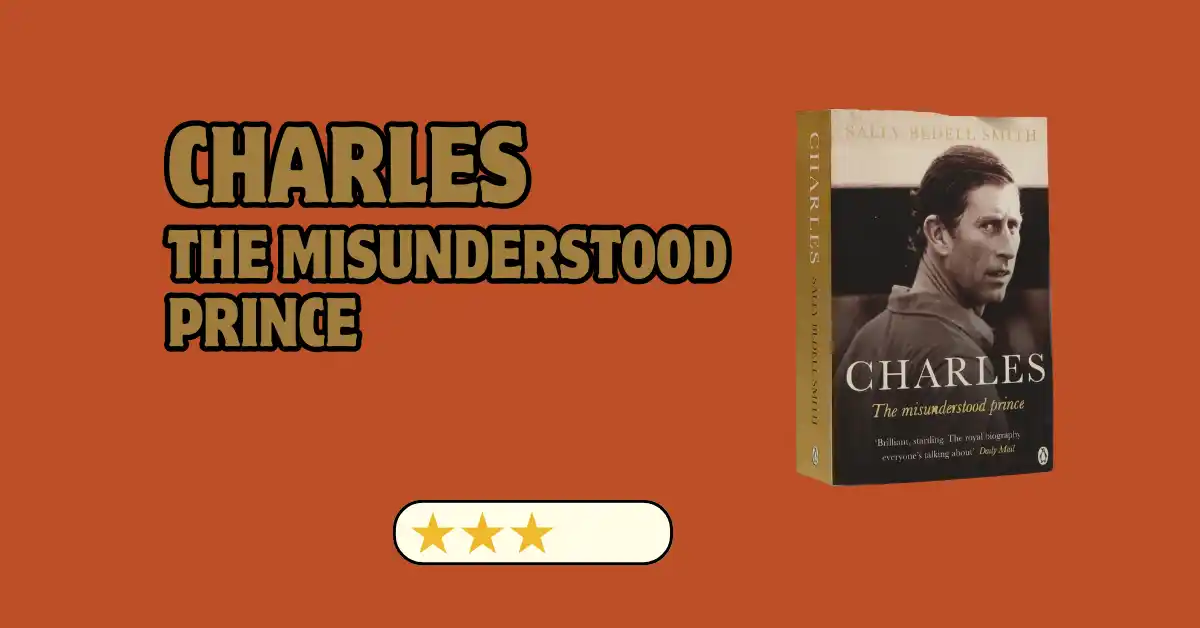
Charles: The Misunderstood Prince — A Review That Questions the Frame
When you pick up a biography, you expect to meet someone as they were, not as they wished to be seen. That expectation becomes more complicated when the subject is a future king (when this book was written – the king now), and the author seems determined to rewrite decades of public perception. This biography of Prince Charles does exactly that. It sets out not just to inform, but to rehabilitate. And while it succeeds in offering a detailed portrait of a complex man, it does so by consistently tilting the lens in his favor.
This is not a neutral telling. It is a sympathetic one. And that choice shapes everything you read.
A Childhood Designed to Explain Everything
The book spends considerable time on Charles as a boy and teenager, painting him as someone who never quite fit the role he was born into. He is described as timorous, a word that immediately softens him. Insecure. Uncertain. A child who needed warmth and got protocol instead. The Queen Mother emerges as his protector, the one person who cosseted him when the rest of the royal machine seemed indifferent to his emotional needs.
His education is presented as an experiment gone wrong. Sent away to schools that prized toughness over tenderness, Charles struggled. The narrative frames this as isolation, not preparation. The implication is clear. His later struggles with intimacy, his difficulty in expressing himself, his emotional distance from those who loved him, all of it traces back to those early years.
But here is where the bias starts to show. Every choice made for him is presented as something done to him. His parents are subtly blamed for not understanding what kind of child they had. The structure of royal life is framed as the villain. And Charles himself becomes the victim of circumstance, shaped by forces beyond his control.
It is a convenient framing. It explains without accusing. It builds sympathy by removing agency. And it sets the stage for every chapter that follows.
The Public Never Understood Him
The biography makes a sustained effort to reposition Charles in the public imagination. For decades, he was seen as stiff, out of touch, even retrograde in his thinking. The press mocked him. The public found him awkward. He was the prince who talked to plants, who seemed more comfortable with tradition than with people.
This book wants you to reconsider all of that. It argues that Charles was misunderstood, that his sensitivity was mistaken for weakness, that his intellectualism was dismissed as eccentricity. He cared about architecture when others saw only concrete and steel. He worried about the environment before it was fashionable. He thought deeply about spirituality and meaning in a world obsessed with appearances.
The author presents all of this as evidence that Charles was ahead of his time, not behind it. And there is some truth in that. But the constant insistence that he was misread starts to feel less like analysis and more like defense. The public image is always wrong. The media is always unfair. Charles is always more complex than anyone gives him credit for.
It is a pattern that repeats throughout the book. And it makes you wonder whether the problem was really perception, or whether perception was reacting to something real.
Marriage, Infidelity, and the Art of Redirection
This is where the biography reveals its deepest bias. The marriage to Diana, the affair with Camilla, the collapse of a union that captivated the world. These are the moments that defined Charles in the public mind. And the way this book handles them tells you everything about its intentions.
Charles is never quite at fault. His infidelity is not presented as a betrayal, but as an inevitability. The narrative constructs a careful argument. Diana was young, inexperienced, emotionally volatile. She did not share his interests. She did not understand his need for intellectual companionship. She demanded attention he could not give and resented the life he offered.
Camilla, by contrast, is framed as his true match. She understood him. She shared his humor, his worldview, his need for a certain kind of partnership. She did not ask him to be someone he was not. The book stops just short of saying the marriage to Diana was doomed from the start, but the implication hangs over every page.
What the biography does, very skillfully, is redirect responsibility. Charles did not fail Diana. The match failed them both. He did not choose infidelity. He returned to the person who had always understood him. His emotional needs are treated as justification, not explanation. And Diana is quietly repositioned as someone who could never have been enough.
It is a deeply troubling way to frame adultery. And it is done with such care, such subtle shifts in language, that you might not notice it happening unless you are paying attention.
Diana and Camilla Through a Slanted Lens
The imbalance in how these two women are treated is one of the most glaring flaws in the book. Diana is rarely portrayed with the same generosity extended to Charles. Her struggles are acknowledged, but they are framed as failings. Her youth becomes immaturity. Her emotional openness becomes instability. Her popularity becomes a problem, something that made Charles feel overshadowed and inadequate.
Camilla, meanwhile, is given every benefit of interpretation. She is patient. She is understanding. She is the woman who loved him when no one else could. The scandal of their affair is softened, presented as a love that survived despite the obstacles placed in its way.
The book does not openly vilify Diana, but it does something more insidious. It diminishes her. It makes her the wrong woman in the wrong place, while Camilla becomes the woman who should have been there all along. The sympathy is clear. And it is entirely one sided.
This is not history. This is narrative control. And it leaves you wondering what version of events you would get if Diana had lived to tell her own story with the same level of authorial support.
The Pattern of Deflection
One of the most striking patterns in the biography is how rarely Charles is presented as the primary cause of anything that goes wrong. Mistakes happen around him, not because of him. Relationships fail due to incompatibility, not his choices. Public perception sours because people misunderstand, not because he gives them reason to.
External circumstances are blamed. Other people are assigned responsibility. And Charles is left looking like someone who tried his best in impossible situations. The Queen is too distant. Philip is too harsh. Diana is too fragile. The press is too cruel. The system is too rigid.
It is never really Charles.
This contributes to a sense that the biography is less interested in understanding him fully and more interested in absolving him. And that is a problem. Because accountability matters. Growth requires it. And a portrait that refuses to hold its subject responsible is not a complete portrait. It is a curated one.
The Strength of the Prose
For all its bias, this is a well written book. The author has clearly done extensive research. The details are rich. The narrative flows smoothly. You are taken through Charles’ life with clarity and care, and the prose never feels labored or defensive, even when the interpretation clearly is.
The book is informative. It gives you a sense of what it was like to grow up royal in a particular era. It shows you the pressures, the expectations, the strange mix of privilege and constraint. It introduces you to a version of Charles that is more human than the one you might have imagined.
But that version is also carefully managed. The strength of the writing almost makes you forget that you are being guided toward a conclusion, not invited to form your own.
What Kind of Reading Experience to Expect

If you come to this book looking for a neutral account, you will be disappointed. This is not a biography that weighs evidence and lets you decide. It is one that has already decided and wants you to agree. That does not make it worthless, but it does make it frustrating if you value balance.
You will learn things. You will see Charles in ways you have not seen him before. You will understand, at least on some level, why he made the choices he did. But you will also feel the tug of authorial sympathy in every chapter, and that tug becomes harder to ignore as the book goes on.
It is informative but curated. Insightful but partial. And whether you find it convincing will depend largely on how willing you are to accept the frame it offers.
Questions You Might Ask Before Buying
Who is Sally Bedell Smith
Sally Bedell Smith is a prominent American historian and biographer with extensive, high-level access to the British Royal Family. She has written major biographies of Queen Elizabeth II, Prince Charles, and Princess Diana. She has also received special permission to access the Royal Archives for her research, notably for George VI and Elizabeth: The Marriage that Saved the Monarchy.
Is this considered an unbiased biography
Public opinion is divided. Many readers appreciate the depth of access and research. Others (including me) feel the portrayal of Charles is highly sympathetic and less critical than other accounts.
Are there other biographies of King Charles that offer a different perspective
Yes. Several biographies approach Charles with more journalistic distance or critical analysis, particularly those written closer to the height of public tensions surrounding his marriage to Diana. Some are seen as more balanced, others openly critical.
Does this book heavily criticise Princess Diana
It does not overtly attack her, but the framing often highlights what she “lacked” in comparison to Camilla, which some readers interpret as subtle bias.
Is this book useful if I want to understand Charles’ upbringing
Yes. The sections on his childhood, schooling, and relationship with the Queen Mother and his parents are detailed and insightful.
Does the book address the adultery and marital breakdown directly
Yes, but the interpretation leans toward emotional justification rather than moral critique.
Who will appreciate this book the most
Readers interested in royal history and those open to a sympathetic portrayal of Charles.
Who might find it frustrating
Readers seeking a strictly neutral or more critical evaluation of Charles’ personal and marital decisions.
Who Should Read This Book
This biography is ideal for readers who are already inclined to view Charles sympathetically. If you have always thought he was misunderstood, if you believe the press was unfair, if you think Diana was as much a problem as a victim, then this book will reinforce everything you already feel.
It is also useful for anyone interested in royal history, particularly the inner workings of the family during a turbulent period. The details about his upbringing, his education, his early years as an adult are genuinely interesting. You get a sense of what shaped him, even if the interpretation of that shaping feels skewed.
But if you are looking for a balanced account, one that gives equal weight to Diana’s perspective or holds Charles accountable for his actions, you will not find it here. If you want a biography that challenges its subject as much as it defends him, this is not that book.
A Biography That Chooses Its Side
In the end, this biography succeeds in doing exactly what it set out to do. It presents Charles as misunderstood. It reframes his life as a series of circumstances that worked against him, rather than choices he made. It builds a case for sympathy, and it does so with skill and care.
But whether it convinces you is another question entirely. Because understanding someone does not mean excusing them. And a portrait that refuses to see fault is not a complete one. It is a defense. And defenses, no matter how well argued, are still trying to win you over.
You can read this book and come away knowing more about Charles. You can appreciate the research, the detail, the narrative craft. But you should also recognize what it is. Not an unbiased biography. A sympathetic one. And that distinction matters more than the author seems willing to admit.
If you want to understand how Charles sees himself — and how a sympathetic biographer frames his life — this is worth reading. Just don’t expect complete neutrality.
Affiliate link. I may earn a small commission at no extra cost to you.