Reading Gujarat’s Last Rajput King Karan Ghelo: When a King’s Personal Failures Destroyed a Kingdom:
Some historical novels turn the past into adventure. They give you heroes to root for, villains to hate, and a clear sense that everything happened for a reason.
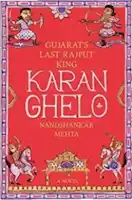
Gujarat’s Last Rajput King: Karan Ghelo by Nand Shankar Mehta is not that kind of book.
This is a novel about failure. About how a kingdom fell not through one dramatic battle, but through a slow collapse caused by personal weakness, political betrayal, and forces too large for any one person to stop.
Karan Ghelo was Gujarat’s last Rajput ruler before it fell to Alauddin Khilji’s Delhi Sultanate in the early 14th century. And this book, written in the 18th century, tells his story—not as a tragic hero brought down by fate, but as a flawed man whose personal choices accelerated a historical catastrophe.
It’s a dense book. Heavy. Slow. The kind that tests your patience with long, detailed descriptions and careful scene-building.
But if you stick with it, you get something remarkable: a window into medieval Indian politics, the brutal realities of conquest, and the moral concerns of 18th-century Hindu reformers trying to make sense of their history.
This isn’t just a story about one king losing one kingdom. It’s about power, desire, betrayal, and how societies justify their defeats by pointing to individual failures.
Who Was Karan Ghelo?
Karan Ghelo (also called Karna) ruled the Vaghela dynasty of Gujarat in the late 13th and early 14th centuries—right when Alauddin Khilji was expanding the Delhi Sultanate and conquering kingdoms across North and West India.
In the traditional telling, Karan might be portrayed as a brave king defending his land against foreign invaders. A tragic hero who fought valiantly but ultimately fell to superior forces.
Mehta’s version is more complicated. And more damning.
His Karan Ghelo is capable when he wants to be. But he’s also fundamentally flawed. He’s driven by love and lust in ways that cloud his judgment, alienate his allies, and ultimately contribute to his downfall.
The book doesn’t let him off the hook by blaming everything on historical inevitability. It says: yes, Alauddin Khilji was powerful. Yes, the political situation was difficult. But Karan also made bad choices. Personal choices. And those choices had political consequences.
This is uncomfortable to read if you’re expecting a straightforward tale of noble resistance. Because Mehta is saying: sometimes kingdoms fall not because the invaders were too strong, but because the defenders were too weak. Too distracted. Too consumed by personal concerns to focus on survival.
Love, Lust, and Betrayal
At the center of Karan’s downfall are his personal desires and the betrayals that follow.
The book portrays how love and lust become catalysts for political ruin. How a king consumed by personal passion loses sight of his responsibilities. How those around him—watching their ruler become increasingly distracted—begin to lose faith, make their own plans, betray their oaths.
This isn’t just a morality tale about self-control. It’s about how personal weakness at the top creates opportunities for political enemies. How distraction becomes vulnerability. How a leader’s private life can destroy public trust.
Mehta is making an argument about power and responsibility. He’s saying: rulers who put personal desire above duty destroy their kingdoms. Individual weakness cascades down to catastrophe for everyone below. A king’s private failures become public disasters.
You can read this as moral judgment—and it is. Mehta, writing in the 18th century, is looking back at this 14th-century ruler and saying: this is what happens when leaders lose control of themselves.
But it’s also political analysis. Because history is full of kingdoms that fell partly because their leaders were distracted, divided, or too concerned with personal matters to see the danger approaching.
Alauddin Khilji’s Rule: Conquest and Control
When Alauddin Khilji’s forces finally conquer Gujarat, the book shifts to show you what conquest actually meant in 14th-century India.
And it’s brutal.
Khilji wasn’t interested in winning hearts and minds. He was interested in control. In making sure conquered people stayed conquered. In extracting wealth and ensuring obedience.
The book shows how this worked in practice:
Jizya or conversion. Non-Muslims faced a choice: pay a special tax (jizya) as the price for practicing their religion, or convert to Islam. This wasn’t a friendly invitation to join a new faith. It was a policy designed to assert dominance and extract resources.
Governance through fear. Rule wasn’t about integration or gradual acceptance. It was about systematic control. About making sure everyone understood who had power now and what would happen if you challenged it.
Power through dominance. The goal wasn’t cooperation. It was submission. Total, unquestioned submission backed by the threat of violence.
Mehta isn’t writing from a modern perspective that tries to be balanced or understanding of all sides. He’s writing as an 18th-century Hindu looking back at Muslim conquest, and his perspective is shaped by that position.
But what’s striking is how clearly he shows the mechanics of power. How conquest isn’t just about winning battles—it’s about establishing systems that keep conquered people subdued. About using religion, economics, and fear to maintain control.
This isn’t subtle. But it’s historically grounded. This is how power worked in medieval India. This is what happened when kingdoms fell.
Women, Patriarchy, and Conquest
One of the most painful aspects of the book is how it portrays what happens to women when kingdoms fall.
The treatment of women during conquest is shown unflinchingly. Women—especially elite women—lose what little protection their status provided. They become vulnerable to violence and exploitation. Their fates are decided entirely by men—whether those men are conquerors, fathers, husbands, or defeated kings.
The book shows women as victims of political and social upheaval they didn’t create and couldn’t control. Their suffering illustrates the human cost of political collapse.
This reflects the medieval patriarchal norms Mehta is describing. Women had limited agency. Their safety depended on male protectors. And when those protections collapsed, women suffered first and worst.
But it also reflects 18th-century attitudes—still deeply patriarchal, even as some reformers were beginning to question certain practices.
From a modern perspective, the limited agency given to female characters is frustrating. They exist mostly in relation to powerful men. But the book is a product of its time, and understanding that context is important for reading it fairly.
After the Fall: Power Struggles and Instability
The book doesn’t end with Karan Ghelo’s defeat. It continues to show what happens after—the political chaos, the competing claims to authority, the moral disintegration that follows conquest.
This is one of the most valuable parts of the book. Because kingdoms don’t just cleanly change hands. There’s always a messy period where different factions try to assert control. Where old loyalties conflict with new realities. Where people have to figure out how to survive in a changed world.
The power vacuum creates its own problems. Without clear authority, without established systems, there’s instability. Violence. Opportunism. People taking advantage of the chaos to settle old scores or grab what they can.
And it shows that conquest doesn’t end when the battle ends. The real aftermath—the long process of establishing new order, dealing with resistance, managing a conquered population—that’s where the brutality becomes systematic rather than just dramatic.
The aftermath sections are slower and harder to read than the conquest itself. But they’re important. They show the full cost of political collapse—not just the immediate loss, but the years of chaos and suffering that follow.
The 18th-Century Lens: History as Social Reform
Here’s something crucial to understand about this book: it wasn’t written in the 14th century when these events happened. It was written in the 18th century—hundreds of years later.
And the 18th century was a time of Hindu social reform. A time when certain thinkers and writers were questioning practices that had become traditional but were starting to seem problematic.
So when you read Karan Ghelo, you’re not just reading about 14th-century events. You’re reading an 18th-century interpretation of those events, filtered through 18th-century concerns.
And this shows up in specific ways:
Explicit criticism of sati. The book condemns the practice of widow immolation. This wasn’t a 14th-century concern—it was an 18th-century reform issue. Mehta uses his historical novel to make a contemporary social argument.
Criticism of caste inequality. The book challenges rigid caste hierarchies. It suggests that caste divisions weakened society and contributed to Gujarat’s fall. Again, this is 18th-century reform thinking being applied to a 14th-century setting.
Moral judgment embedded in history. The emphasis on Karan’s personal failures as the cause of political collapse reflects reformist ideas about individual responsibility, moral leadership, and social organization.
This isn’t a flaw. It’s just important to understand what you’re reading. This is history as moral instruction. History used to make arguments about how society should be organized and what values matter.
Mehta isn’t trying to give you objective 14th-century history. He’s using that history to talk about his own time. To argue for reform. To show how personal and political failures are connected. To criticize practices he sees as harmful.
This makes the book a fascinating historical document in its own right—not just for what it tells you about the 14th century, but for what it tells you about 18th-century Hindu reformist thought.
The Reading Experience: Like Watching a Historical Film
I need to be honest about what it’s like to read this book: it’s hard work.
Mehta writes with incredible detail. Heavy, descriptive passages fill the pages. He describes everything—landscapes, clothing, ceremonies, battles, court proceedings. He takes his time building scenes, setting mood, establishing context.
The pacing is deliberately slow. You’ll read pages and pages where not much happens plot-wise. Where you’re just absorbing atmosphere and detail.
If you’re used to modern historical fiction that moves quickly and focuses on action, this will test your patience. There were sections where I had to push myself to keep reading. Where I thought “okay, I get it, can we move on now?”
But here’s the thing: all that detail, all that careful scene-building, creates something cinematic. Like you’re watching a historical film unfold slowly in front of you.
You’re not just reading about events—you’re witnessing them. You’re there in the court, at the battle, in the aftermath. The world feels completely real because Mehta has shown you every detail of it.
So the question is: are you willing to work for it? Are you okay with a book that demands patience but rewards that patience with depth and immersion?
The payoff is there if you can endure the density. But you have to be willing to sit through the slow parts to get to it.
Why This Book Still Matters
Gujarat’s Last Rajput King: Karan Ghelo was written over 200 years ago about events that happened over 700 years ago.
So why read it now?
Because it shows you how people make sense of historical trauma. How they construct narratives to explain why bad things happened. How they use the past to argue about the present.
Gujarat’s fall to the Delhi Sultanate was a major event in regional history. And for centuries afterward, people told different stories about what that fall meant and why it happened.
Mehta’s version blames personal failure and social weakness. He says: we fell because our leaders were flawed and our society was divided by harmful practices like caste inequality and sati. And by extension: if we want to avoid future disasters, we need better leaders and a reformed society.
This is how history gets used. Not just to record what happened, but to teach lessons. To justify reforms. To shape how people understand themselves and their society.
And that’s still relevant. Because we still do this. We still tell stories about historical events that reflect our current concerns. We still use the past to argue about the present.
Reading Mehta’s version of Karan Ghelo’s story—with all its moral judgments and reform agenda—reminds you that history is never just facts. It’s always interpretation. Always shaped by who’s telling it and why.
Who Should Read This
Gujarat’s Last Rajput King is definitely not for everyone.
You’ll probably appreciate it if:
- You’re interested in medieval Indian history, especially Gujarat
- You want to understand 18th-century Hindu reformist thought
- You can handle slow, descriptive, dense prose
- You like books that feel cinematic and immersive
- You’re interested in how historical trauma gets interpreted
- You want to see how personal and political failures intersect
- You appreciate books that use history to make moral arguments
- You’re patient enough to let a story unfold at its own pace
- You’re curious about Alauddin Khilji’s policies and medieval conquest
You might struggle with it if:
- You want fast-paced historical fiction
- You need modern sensibilities about women and agency
- You get frustrated with long descriptive passages
- You want clear heroes and villains
- You prefer books where events move quickly
- You can’t handle slow pacing even when it serves a purpose
This is a book for serious readers of historical fiction. For people who understand that older books have different pacing and different values. For readers who can appreciate what a book does well while acknowledging its limitations.
Final Thoughts
Gujarat’s Last Rajput King: Karan Ghelo is not a swift or forgiving book. But like history itself, it insists on being witnessed in full.
It doesn’t give you easy answers about why kingdoms fall or what lessons we should learn. It shows you one version of events—filtered through 18th-century moral concerns, shaped by reformist agendas, but grounded in real historical trauma.
It’s a book that asks you to work for it. To be patient with its pace. To sit with its heavy descriptions. To understand both what it’s showing you about the 14th century and what it’s arguing about the 18th century.
The slow erosion of Karan Ghelo’s kingdom—driven by personal weakness, political betrayal, and historical inevitability—unfolds page by page, detail by detail, until you’ve witnessed the complete collapse.
And if you can meet it where it is rather than where you wish it would be, you’ll find something valuable.
A window into how people made sense of conquest and collapse. A document of 18th-century reform thought. A reminder that personal choices have political consequences. A story about how desire, weakness, and social division can destroy not just individuals but entire societies.
Sometimes the most important books aren’t the most comfortable ones. They’re the ones that show you how messy and complicated history really is—how it’s never just about good versus evil, but about flawed people making difficult choices in impossible situations, and how those choices echo through generations as people try to understand what went wrong and how to do better.
Karan Ghelo is that kind of book. Dense, difficult, slow—but honest about the complexity of history and the challenge of learning from it. It rewards patience with depth, and discomfort with understanding.
Ready to read a historical tale where love, betrayal, and political choices lead to the fall of Gujarat’s last Rajput king?
Disclosure: This is an Amazon affiliate link. I may earn a small commission at no extra cost to you.