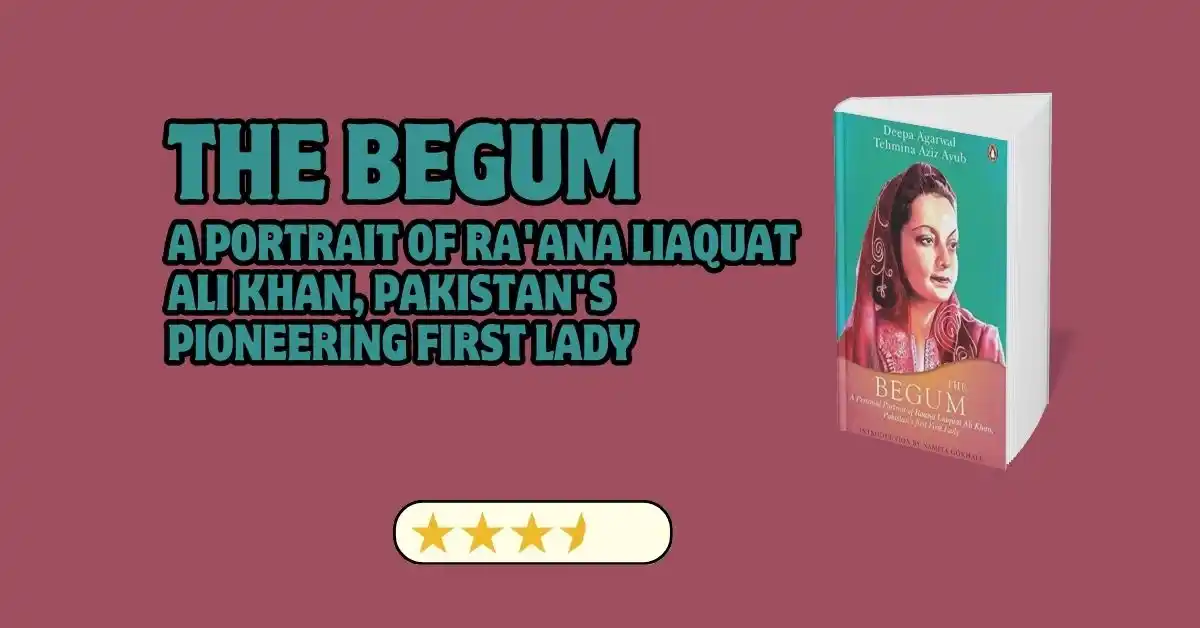
The Begum – A Portrait of Ra’ana Liaquat Ali Khan
There are names we hear in history podcasts that we forget once it ends. And then there are names that deserve to stay with us, not because someone told us they matter, but because when we look closely, we realize they shaped things far more than we ever knew.
Ra’ana Liaquat Ali Khan is one of those names. Most people, if they know her at all, think of her as the wife of Liaquat Ali Khan, one of the founding leaders of Pakistan. But that is like saying the ocean is just water. It is true, but it leaves out everything that makes it alive.
This book, simply put, is about a woman who lived a life of real choices. Not the kind of choices that sound big in books but feel small in the living. These were choices that cost her something every single time she made them. She gave up safety, comfort, and the life she had known, again and again, because she believed in something bigger than herself.
This is not a book that puts her on a pedestal. It does not turn her into a saint or a symbol. It reads more like a quiet conversation, one where you sit down, listen, and slowly begin to understand the kind of person she was. And that, in the end, is what makes it so worth reading.
A Girl Named Irene, From a Place Called Almora
Before she was a Begum, before she was a diplomat, before any of the big titles and important roles, she was simply Irene. Irene Pant. Born in Almora, a small town tucked into the hills of what is now Uttarakhand in India. It was a quiet place, green and cool, the kind of place where life moved at its own pace and the rest of the world felt far away.
Her family, the Pants, came from a Kumaoni Brahmin background. But two generations before her birth, they had converted to Christianity. This single fact tells you a great deal about who Ra’ana would become. Her family had already shown, before she was even born, that they were willing to step outside the lines that society drew for them. They had already proved that belief mattered more to them than belonging.
Growing up in this family, Irene was not told to stay quiet or stay small. She was educated. She was encouraged to think. She was raised with a sense of herself, a feeling that she had a mind worth using and a voice worth hearing. In a time and place where many girls were taught that their lives would begin and end inside someone else’s home, Irene was taught something very different. She was taught that the world was wide, and that she had every right to walk through it.
This early life matters because it explains everything that came after. So many women through history have been remembered only because of the man they stood beside, turned into symbols of someone else’s story rather than authors of their own, much like Mumtaz Mahal, whose name lives on through a tomb rather than through her own voice. Irene was being raised to be something different. A woman who has been told from the start that she is capable does not suddenly become timid when things get hard. She carries that belief with her, like a quiet fire, and it keeps burning even when the winds blow against her.
The Day She Chose Liaquat Ali Khan
Now here is where the story begins to move, and where many people get the wrong idea about Ra’ana. When she married Liaquat Ali Khan, people looked at it and saw what they always see when a woman marries a powerful man. They saw a woman stepping into his shadow. They assumed she had simply followed the path laid out for her.
But that is not what happened.
Ra’ana chose Liaquat Ali Khan. She chose him knowing full well what that choice would mean. She knew it would take her away from the life she had grown up in. She knew it would pull her out of the familiar, the safe, the comfortable. She knew that his world was one of politics, of public life, of noise and risk and uncertainty. And she said yes anyway.
This was not a woman drifting into someone else’s story. This was a woman writing her own. She looked at the road ahead, the one that was harder, messier, and less certain, and she walked onto it with her eyes open. It is a kind of courage that shows up again and again in the lives of women who chose loyalty and purpose over safety, women like the ones explored in The Legend of Virinara, where power, devotion, and survival are all tangled together. There is a word for what Ra’ana did, and it is not sacrifice. It is agency. It is the freedom to choose, even when the choosing is not easy.
Understanding this one moment, this single decision, is the key to understanding everything else Ra’ana did in her life. She was never someone who let things happen to her. She was someone who made things happen.
What Feminism Looked Like Before Anyone Called It That
Ra’ana Liaquat Ali Khan was a feminist. But she did not call herself one, not in the way we use that word today. She did not write articles or give speeches about women’s rights. She did not argue and debate and shout from stages.
She built things.
She built schools. She built programmes. She built organisations that put food in front of hungry women, that opened doors to education for girls who had never been inside a classroom, that gave women a path to earn their own money and stand on their own feet. She looked at the problems that women faced every single day, the small, quiet, invisible ones that no one talked about, and she said, “Right. Let us fix this.”
That is what feminism looked like before it had a big name and a big movement behind it. It looked like someone rolling up their sleeves and getting to work. It looked like Ra’ana.
This is one of the things the book does so well. It does not paint her as a great thinker or a great speaker. It shows her as a great doer. And in many ways, that is a harder thing to be. Talking about change is easy. Making it happen, one small step at a time, in a world that is not always interested in helping you, that is something else entirely.
Building a Nation, One Life at a Time
Pakistan, when it came into being in 1947, was not a finished thing. It was raw and new and full of questions. Who would it be? What would it stand for? How would it hold itself together when so many forces were pulling it apart?
The book gives us glimpses into this time, not through the language of politics or policy, but through the eyes of someone who was living inside it. We see Muhammad Ali Jinnah, not as the figure from the history books but as a real person in a room. We see Liaquat Ali Khan working, thinking, carrying the weight of a country on his shoulders. And we see Ra’ana beside him, not as decoration but as someone who understood what was happening and who cared deeply about what Pakistan could become.
This is history the way most of us will never read it. It is not written from a distance. It is written from the inside, from the kitchen table, from the conversations that happened after the meetings ended, from the quiet moments that no one thought to record. And because of that, it feels true in a way that grand histories often do not.
Ra’ana was not building a nation the way leaders build nations, with speeches and signatures. She was building it the way most nations are actually built, one person at a time, one family at a time, one small act of care at a time.
After the Loss
In 1951, Liaquat Ali Khan was assassinated. He was shot and killed in broad daylight, in front of thousands of people. It was one of the most shocking moments in Pakistan’s early history, and it changed everything for Ra’ana overnight.
She was now alone. She had children to raise. She had very little money. The political world that had been her home for years suddenly felt very different without the person who had been at its centre. The protection that came with being the wife of a leader was gone. The power, the access, the voice, all of it changed in an instant.
Most people, when they lose that much, pull back. They close the doors. They retreat into grief and let the world carry on without them. And no one would have blamed Ra’ana if she had done exactly that.
But she did not.
Instead, she picked herself up. She found new ways to be useful. She found new reasons to show up. She did not disappear into the background of someone else’s story. She stepped forward into her own, even when stepping forward was the harder thing to do.
This part of Ra’ana’s life is, in many ways, the most important part. It is easy to be brave when things are going well. It is easy to keep moving when the wind is behind you. But to keep going when everything has been taken from you, when the ground has shifted under your feet and you have to learn to walk again, that is a different kind of strength. It is the kind of strength that is not chosen so much as it is built, slowly, out of what is left after the worst has already happened, the same quiet, hard truth that runs through Still Bleeding From the Wound. And Ra’ana had it.
A Woman Who Became Her Own Country’s Voice Abroad
After her husband’s death, Ra’ana did something that very few women in her time would have done. She entered Pakistan’s foreign service. She became a diplomat.
She served as an ambassador in the Netherlands, in Italy, and in Tunisia. She carried her country’s name into rooms where very few women sat. She spoke on behalf of a nation that was still finding its own voice, and she did it with a grace and a sharpness that made people listen.
Think about what this meant in real terms. She was a woman, recently widowed, in a world where men held almost all the power. She was representing a country that was young and still proving itself on the world stage. And she did it not because someone pushed her into it, but because she chose it, the same way she had chosen everything else in her life.
Reinvention is a word we use a lot these days, but most of the time it just means changing your job or your style. For Ra’ana, reinvention meant something much bigger. It meant taking the wreckage of one life and building something entirely new from it. It meant saying, “I am still here. I still matter. And I still have work to do.”
Service, for Ra’ana, was never about status. It was never about titles or titles on a door. It was about being useful. It was about showing up and doing the thing that needed doing, even when no one was watching, even when the reward was simply the work itself.
The All Pakistan Women’s Association and What It Really Meant
If there is one thing Ra’ana Liaquat Ali Khan will be remembered for, it is the All Pakistan Women’s Association, known as APWA. This was not just an organisation. It was the shape of her belief made real.
APWA worked on education. It worked on healthcare. It worked on helping women earn money and become independent in ways that were not always easy or quick. It worked on the small, unglamorous, day to day things that actually change lives, not the big announcements that sound impressive but disappear the next morning.
Ra’ana built APWA not as a monument to herself but as a tool for other women. She wanted it to outlive her. She wanted it to keep working long after she was gone. And in many ways, it has. The organisation she helped shape continued to do its quiet, steady work for years after her lifetime ended.
This is what feminism looks like when it is not performed for an audience. It looks like someone saying, “These women need help. Let us help them.” And then actually doing it. No speeches. No grand gestures. Just work. Real, honest, unglamorous work that changes the way women live their lives. It is a very different thing from feminism that lives in words and arguments, the kind of gap that Pen Yen Adimaiyanaal also holds up to the light, asking what happens when ideas meet the ground and have to become something real.
APWA grounded Ra’ana’s belief in something concrete. It took all the ideas she held, about education, about independence, about what women deserved, and it turned them into something you could point to and say, “Look. This is real. This happened. This helped.”
How the Book Is Written and Why It Works
The book does not read like most biographies. It does not feel like someone listing facts or trying to make Ra’ana look good. It feels more like someone trying to tell the truth, even when the truth is complicated, even when it does not fit neatly into a story.
There is a balance here between the public life and the private one. We see the diplomat and the mother. We see the leader and the woman who had to figure out how to pay her bills after her husband was killed. We see the big moments and the small ones, and somehow the small ones feel just as important.
The book does not turn Ra’ana into a symbol. That is perhaps its greatest strength. Symbols are useful, but they are also flat. They do not breathe. They do not feel real. Ra’ana, as she is written here, feels real. She feels like someone you could have met, someone you could have sat across from at a table and had a real conversation with.
The writing is quiet and thoughtful. It does not shout. It does not try to impress. It simply tells, and in the telling, it lets Ra’ana’s life speak for itself. And her life, as it turns out, has a great deal to say.
Questions You Might Want to Ask Before Buying This Book
Is this a political biography or a personal one
It is both. The book traces Ra’ana Liaquat Ali Khan’s personal choices while situating them within the political birth of Pakistan.
Do I need prior knowledge of Pakistan’s history
No. Familiarity helps, but the book provides enough context to follow her life and the period she lived in.
Is this book only about being a First Lady
Not at all. Much of the book focuses on her life beyond that role, especially her work after her husband’s death.
Does the book address women’s rights directly
Yes, but through action rather than theory. Her feminism comes through institutions, diplomacy, and welfare work.
How accurate is the book historically
Broadly reliable in its historical framework. Some interpretations and emphases are debated, but the book offers strong insight into Mughal-era legacies, early Pakistan politics, and women’s roles.
Is this an inspiring read or a heavy one
It is quietly inspiring rather than dramatic. The strength lies in persistence, not spectacle.
Who will enjoy this book the most
Readers interested in South Asian history, women in public life, and biographies that value substance over sentiment.
How to Read This Book and What to Take From It
This is not the kind of thing you pick up looking for excitement or drama or a fast-moving plot. It is the kind of book you sit with. You read a chapter. You think about it. You let it sit in your mind for a while before you move on.
It will make you think about women in history and how often their stories get left out or pushed to the edges. It will make you think about what it costs to build a country, not just in money or policy but in the lives of the people who give themselves to it. It will make you think about what it means to keep going when everything around you has changed.
It is an honest book about an honest life. And those are the kinds of books that stay with you long after you have finished reading them.
Who Will Enjoy This Book
If you enjoy reading about real people and real lives, this book is for you. If you are interested in the history of South Asia and want to see it through someone’s eyes rather than through a textbook, this book is for you. If you are looking for stories about women that go beyond the usual footnotes, that treat women as the main characters and not the side ones, this book is very much for you.
If you are hoping for something dramatic or fictional, something with twists and tension on every page, this may not be the right fit. If you are looking for deep political analysis or heavy theory, you will not find much of that here either. This is a personal book. It is about a person. And its power comes from that.
A Life That Reminds Us What History Is Really Made Of
We have a habit of thinking that history is made by the people who hold the most power, the presidents and the prime ministers, the ones whose names are on the big decisions. And they matter, of course they do. But history is also made by the people who work quietly, who build things that last, who keep going after the world has given them every reason to stop.
Ra’ana Liaquat Ali Khan was one of those people. She did not shout for attention. She did not demand a place in the story. She simply lived in a way that made the story bigger, richer, and truer. She built institutions. She sustained causes. She persisted after loss in a way that most of us can only admire from a distance.
Her life reminds us that history is not shaped only by those in power. It is also shaped by those who quietly, patiently, and with great courage, build the world that the rest of us get to live in.
This book is a portrait of that kind of life. And it is a portrait very well drawn.
If you want to read about a woman who shaped history by choosing service over status, this biography is worth your time.
Affiliate link. I may earn a small commission at no extra cost to you.