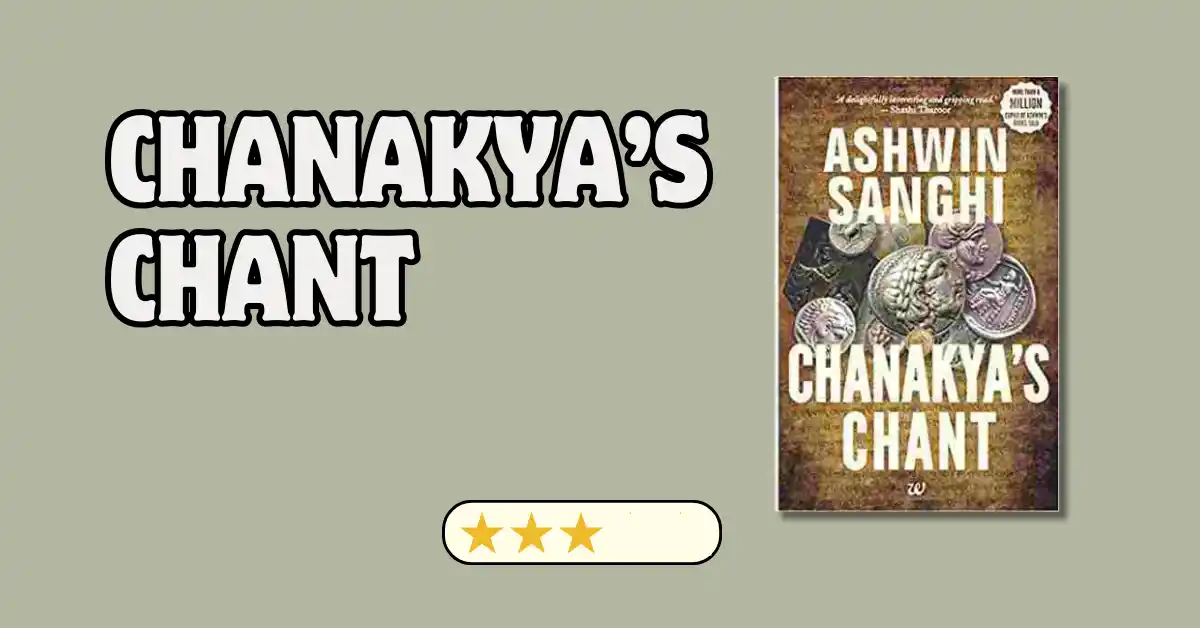
The Chanakya Chant: When Everyone’s Plans Work Too Well
There’s a difference between telling readers a character is brilliant and actually showing them brilliance at work.
The Chanakya Chant by Ashwin Sanghi understands this distinction in theory. In practice, it consistently chooses the easier path: asserting intelligence rather than earning it.
The book runs two parallel timelines. One follows Chanakya in ancient India as he engineers Chandragupta Maurya’s rise to power. The other follows Gangasagar Mishra—a modern political strategist positioned as Chanakya’s contemporary equivalent—as he orchestrates a similar ascent in present-day India.
The premise is ambitious. Two master strategists separated by millennia but connected by method, philosophy, and ruthless clarity of purpose. The ancient timeline gives you historical weight. The modern one shows how those same tactics might work today.
But here’s the problem: both timelines are flat. Both suffer from the same fundamental weakness—their protagonists succeed too easily, face no meaningful resistance, and never demonstrate the kind of intelligence the book keeps insisting they possess.
You’re told these men are geniuses. Repeatedly. But you’re never made to feel it.
Two Timelines That Mirror Each Other’s Flaws
The dual-timeline structure should be this book’s strength. Ancient India and modern India. The same strategies playing out across centuries. Themes echoing and enriching each other.
Instead, the structure amplifies the book’s weaknesses. Because both timelines have the same problem: no friction.
In the ancient timeline, Chanakya maneuvers his way through Magadha’s politics with barely a stumble. His plans work. His predictions prove accurate. His manipulations succeed. Chandragupta follows his guidance and rises as planned.
In the modern timeline, Gangasagar does the same thing. His strategies unfold exactly as designed. His candidate wins. His opponents fall into his traps. Everything proceeds according to plan.
There’s no meaningful failure in either timeline. No moment where the strategist has to pivot because reality refused to cooperate. No opposition smart enough to see through the manipulation. No uncertainty about outcomes.
And without resistance, without the possibility of failure, strategy stops being interesting. It becomes a foregone conclusion you’re just waiting to watch play out.
When Ancient India Sounds Like a TED Talk
The Chanakya timeline should transport you to ancient Magadha. To a world of kingdoms and empires, philosophical schools competing for influence, brutal political realities shaped by entirely different values than our own.
Instead, Chanakya sounds like he’s been reading modern management books.
His dialogue doesn’t feel rooted in his time or philosophical tradition. It feels designed to sound wise in a quotable, shareable way. The kind of wisdom that works well in inspirational memes but doesn’t actually reflect how people in ancient India thought, spoke, or conceptualized power.
Historical figures having modern sensibilities is a common problem in historical fiction. But it’s particularly damaging here because the entire point is Chanakya’s intelligence. His strategic brilliance. His deep understanding of human nature and political systems.
But the brilliance we’re shown is generic. Applicable to any time, any place. Nothing about it feels specifically rooted in the philosophical traditions of ancient India, the political realities of the Mauryan period, or the genuine complexities of that historical moment.
You could transplant these same “wise” observations into a corporate thriller or a fantasy novel and they’d work just as well—because they’re not actually connected to the world they supposedly emerge from.
This breaks immersion. You stop believing you’re in ancient India and start feeling like you’re reading an author’s ideas about strategy dressed up in historical costumes.
The Modern Timeline: Plans That Never Fail
Gangasagar Mishra is the modern Chanakya. A political strategist working behind the scenes to create a Prime Minister.
And every single thing he plans works perfectly.
He identifies the right candidate. Orchestrates the right alliances. Anticipates every obstacle. Manipulates media, opponents, party members—everyone—with flawless precision.
There are no surprises. No moments where someone sees through his manipulation and counters effectively. No allies who betray him. No plans that backfire. No genuine uncertainty about whether he’ll succeed.
This should be thrilling. Watching a master strategist at work, several moves ahead of everyone else.
Instead, it’s boring. Because strategy only matters when there’s opposition. When there’s a real possibility of failure. When the strategist has to adapt, improvise, rethink everything because reality refused to cooperate.
Chess is interesting because both players are trying to win. If one player makes all the right moves and the other just watches passively as they get checkmated, it’s not strategy—it’s demonstration.
That’s what the modern timeline feels like. A demonstration of Gangasagar’s intelligence rather than a genuine test of it.
Intelligence Declared, Not Demonstrated
Here’s the core problem with both timelines: you’re constantly told these men are brilliant, but you’re never shown why in ways that feel earned.
Real intelligence in fiction emerges through contrast. The brilliant character solves problems others can’t. Sees connections others miss. Succeeds where failure seemed certain.
But when everyone else in the story is either incompetent or passive, when no one offers meaningful resistance, when every plan succeeds—there’s no contrast. No demonstration of superior intelligence. Just assertion.
The book tells you: Chanakya is a master strategist. Gangasagar is a genius manipulator.
But it never puts them in situations where they have to prove it against worthy opposition.
It’s like watching someone claim to be a chess grandmaster but only ever playing against beginners who don’t know the rules. Sure, they win every game. But what does that actually tell you about their skill?
The absence of meaningful failure—of moments where plans go wrong and have to be salvaged, where opponents prove surprisingly capable, where strategy requires genuine adaptation—means the intelligence you’re told about never feels real.
Where’s the Friction?
Great political thrillers thrive on friction. On smart people facing other smart people. On plans colliding with reality and having to be adjusted. On the uncertainty of whether brilliance will be enough.
The Chanakya Chant has no friction.
Opposition exists nominally—there are rival politicians, competing factions, obstacles to overcome. But none of them pose genuine threats. None of them force the protagonists to fundamentally rethink their approach.
Everything unfolds smoothly. Predictably. Exactly as planned.
And that removes tension. Without tension, without genuine uncertainty about outcomes, the forward momentum feels hollow.
You keep reading not because you’re wondering what will happen—the book makes it clear the protagonists will succeed—but just to see the mechanics of how the predetermined success unfolds.
That’s not enough. Not for a book built around the promise of strategic intelligence and political maneuvering.
The Parallel Structure That Doesn’t Pay Off
Using parallel timelines should create opportunities for resonance, contrast, complication.
Maybe the ancient timeline shows certain strategies working in that context, while the modern timeline reveals their limitations today. Or vice versa.
Maybe one timeline challenges the moral assumptions of the other. Shows consequences the other timeline glosses over.
Maybe one strategist fails where the other succeeds, illuminating what’s different about their approaches or their circumstances.
But The Chanakya Chant doesn’t do any of that. Both timelines just… agree with each other. Echo each other. Reinforce the same messages.
The parallelism becomes repetitive rather than illuminating. You’re essentially reading the same story twice in different settings, and neither version has enough depth to justify the doubling.
The opportunity to let these timelines complicate each other—to show how strategy works differently across contexts, or to question whether ancient wisdom actually translates to modern politics—gets completely missed.
Reading Experience: Fast but Shallow
To be fair, the book moves quickly. The pacing is brisk. Chapters are short. You’re never bogged down.
If you’re looking for something that reads easily, that doesn’t demand much from you, that provides clear winners and straightforward trajectories—this delivers that.
But it reads more like an outline than a lived narrative. More like a series of strategic moves being demonstrated than actual human drama unfolding.
The writing is functional. Gets you from point A to point B efficiently. But there’s no emotional resonance. No moments that linger. No characters who feel like real people rather than chess pieces in the author’s demonstration of strategic principles.
It’s smooth. But smooth in the way corporate presentations are smooth—polished but ultimately empty of genuine feeling or complexity.
Who This Book Works For
The Chanakya Chant will appeal to certain readers and frustrate others. It’s worth being clear about which camp you’ll likely fall into.
You’ll probably enjoy this if:
- You like fast-paced plots that don’t require much emotional investment
- You prefer clear victories over ambiguous outcomes
- You’re more interested in what happens than why it matters
- You enjoy feeling like you’re learning strategy even if it’s surface-level
- You’re a fan of Ashwin Sanghi’s other work and know what to expect
- You want something light that feels intellectually substantial without actually being challenging
You might be disappointed if:
- You expect political thrillers to have genuine tension and uncertainty
- You want characters with interior lives and emotional complexity
- You’re looking for historically grounded portrayals of ancient India
- You need antagonists who pose real threats
- You expect intelligence to be demonstrated through problem-solving rather than declared through narration
- You want moral ambiguity or consequences that complicate easy victories
This is a book for readers who find comfort in competence, who enjoy watching plans unfold without hiccups, who prefer their protagonists unchallenged and their outcomes assured.
It’s not for readers expecting the kind of political chess where both sides are genuinely dangerous to each other. Where intelligence means adapting to failure, not just executing flawless plans.
The Concept Versus the Execution
There’s a genuinely interesting book buried in this premise.
A dual-timeline exploration of political strategy across centuries. Ancient wisdom tested in modern contexts. The question of whether human nature and power dynamics are constant or whether context fundamentally changes how strategy works.
But to deliver on that promise, you’d need:
Characters who feel like people, not mouthpieces for strategic principles. Opposition that poses genuine challenges. Moments where plans fail and strategists have to scramble. Historical settings that feel authentic rather than generic. Modern politics portrayed with real complexity rather than simplified mechanics.
Most importantly, you’d need to trust readers to recognize intelligence when they see it rather than constantly asserting it.
The Chanakya Chant has the concept but not the execution. It has ambition but not the craft to fulfill it. It wants to be a sophisticated exploration of power and strategy but settles for being a competent thriller that tells you it’s sophisticated without actually doing the work.
Final Assessment
The Chanakya Chant is not a bad book in the sense of being unreadable or incompetent. It’s professionally written. It moves at a good pace. It will entertain readers looking for easy, unchallenging fare.
But it fails to deliver on its central promise: to show you strategic brilliance at work.
Instead, it asserts brilliance while showing you plans that succeed because opposition is weak rather than because the strategist is exceptional. It declares intelligence while writing dialogue that sounds modern rather than rooted in authentic philosophical tradition. It creates parallel timelines that should enrich each other but instead just repeat the same flaws.
The book reads like Sanghi had ideas about strategy he wanted to communicate and built a narrative structure to deliver those ideas—but never quite figured out how to make the ideas emerge organically from believable characters facing genuine challenges.
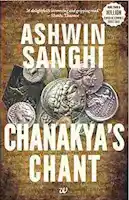
Intelligence without resistance feels hollow. Strategy without the possibility of failure lacks tension. Brilliance that’s declared rather than earned never quite convinces.
The Chanakya Chant gives you two supposedly brilliant strategists executing flawless plans. But flawless execution isn’t the same as compelling storytelling. And assertion isn’t the same as demonstration.
The book wants to be about intelligence, strategy, and the timeless nature of political maneuvering. But it ends up being about how easy everything becomes when your opposition is conveniently incompetent and reality obligingly cooperates with your plans.
That’s not strategy. That’s just wish fulfillment with historical window dressing.
This is a smooth, idea-driven thriller where ambition matters more than depth—read it if that works for you.
Affiliate link. I may earn a small commission at no extra cost to you.