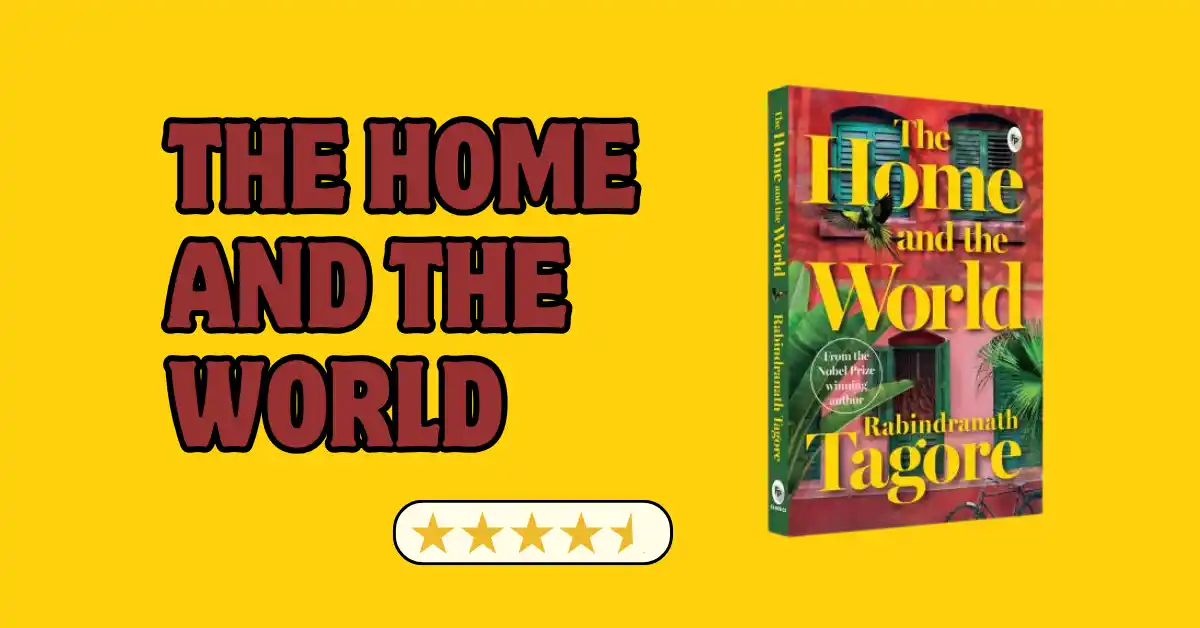
The Home and the World: When Politics Enters Your Marriage
Some books are love stories. Some are political novels. The Home and the World by Rabindranath Tagore is both, and that’s exactly why it’s so unsettling.
On the surface, it’s about a love triangle. Bimala, a traditional wife. Nikhil, her gentle, educated husband. Sandip, a charismatic revolutionary who stirs something in her she didn’t know existed.
But underneath that, it’s about what happens when big political ideas crash into private lives. When nationalism stops being abstract and starts demanding things from you personally. When the revolutionary who sounds so inspiring in speeches turns out to be manipulative and selfish up close.
Tagore wrote this during the Swadeshi movement in early 20th century Bengal, when Indians were boycotting British goods and pushing for independence. He supported the movement at first. But then he saw the violence. The way people used patriotism to justify cruelty. The way noble goals got twisted into something ugly.
So he wrote this novel. Not to attack independence, but to question what happens when nationalism becomes so aggressive that it stops caring about actual human beings.
And the genius of the book is that he doesn’t lecture you about politics. He just shows you three people in a house, dealing with love and loyalty and ideology, and lets you see how dangerous ideas can be when they stop being ideas and start demanding sacrifices.
Three People, Three Ways of Seeing the World
Bimala
Bimala starts as a traditional wife. Devoted to her husband, living mostly within the home, following the old ways.
But Nikhil encourages her to step out. To learn. To think for herself. To enter the world beyond their house.
And she does. She gets involved in the Swadeshi movement. Meets Sandip. And suddenly she’s awake in ways she’s never been before. Feeling things, wanting things, questioning things.
But here’s the problem. She confuses political passion with personal liberation. She thinks the fire she feels when Sandip talks about freedom is the same as actually being free. She mistakes being swept up in a movement for having her own voice.
Her journey mirrors Tagore’s own. He got caught up in Swadeshi’s energy too, before realizing how destructive it could be.
Nikhil
Nikhil is educated, thoughtful, restrained. He wants independence for India but not at the cost of humanity. He believes in education, fairness, treating people with dignity even when you disagree with them.
He supports Bimala’s growth. Wants her to be more than just his wife. Encourages her to think independently.
But he also sees what Sandip really is. Sees through the revolutionary rhetoric to the selfishness underneath. And he refuses to use violence or coercion to achieve political goals, even when everyone around him is doing exactly that.
A lot of people read Nikhil as weak. Too patient. Too willing to let Bimala make her own choices even when those choices hurt him.
But that’s the point. Real strength, real conviction, doesn’t need to control or manipulate. Nikhil represents what Tagore believed in, humanism that stays humane even under pressure.
Sandip
Sandip is the revolutionary everyone’s drawn to. Charismatic. Passionate. Says all the right things about freedom and patriotism and sacrifice.
But watch what he actually does. He manipulates. He lies. He uses people. He justifies everything, every cruelty, every betrayal, by saying it’s for the cause.
He talks about loving India but he treats actual Indians like tools. He claims to believe in freedom but he constantly tries to control Bimala.
He’s nationalism without ethics. Patriotism without compassion. All the inspiring words with none of the actual care for human beings those words are supposed to represent.
And that’s Tagore’s critique. Not of independence itself, but of the kind of nationalism that stops seeing people as people and starts seeing them as symbols or obstacles or fuel for the movement.
When Home Meets World
The title tells you what the book is about. Home versus world. Private life versus public ideology.
Home is where ethics live. Where you have to actually look at the people you’re affecting. Where abstract ideas meet real consequences. Where you can’t hide behind grand causes because the person you hurt is sitting across from you at dinner.
World is ideology. Movements. Mass politics. Abstractions. Where it’s easier to justify things because you’re not seeing the individual faces of the people you’re using or hurting.
The danger the book shows isn’t that Bimala enters the world. It’s that she brings the world’s logic into the home. That she starts treating her marriage, her husband, her actual life as less important than the cause.
That she stops seeing Nikhil as a person and starts seeing him as not revolutionary enough. Not passionate enough. An obstacle to her awakening.
Ideology makes things simple. Good guys and bad guys. Right side and wrong side. Us and them.
But home forces you to see complexity. To recognize that the person who disagrees with you still loves you. That good people can have different ideas about what’s right. That loyalty and love matter even when they’re not politically convenient.
Nationalism Versus Humanity
There’s a Tagore quote that captures what this book is doing. “I will never allow patriotism to triumph over humanity as long as I live.”
That’s the question at the heart of everything. When your country’s freedom conflicts with treating individual humans with compassion, which wins?
Sandip’s answer is clear. The cause matters more. India’s independence justifies whatever means necessary. If some people get hurt, if some communities get divided, if some ethical lines get crossed, that’s acceptable sacrifice for the greater goal.
Nikhil’s answer is different. If you betray your humanity in pursuit of freedom, what you end up with isn’t freedom. It’s just a different kind of oppression.
The book isn’t saying don’t fight for independence. It’s saying don’t become monsters while fighting. Don’t use noble goals to justify ignoble methods. Don’t sacrifice real humans for abstract ideals.
And it shows how easy it is to slide into that. How inspiring rhetoric can make cruelty feel righteous. How being part of a movement can make you stop thinking clearly about whether what you’re actually doing is right.
Women’s Liberation, But Make It Complicated
A lot of people read Bimala’s story as empowerment. She breaks free from tradition, enters public life, discovers herself.
And that’s partly true. Nikhil genuinely wants her to grow beyond the limited role traditional society gave her.
But Tagore’s more critical than that. He’s asking whether Bimala’s liberation is real or just another form of being used.
Because she’s not making fully independent choices. She’s being manipulated by Sandip. Her awakening comes through someone who’s using her political enthusiasm to get close to her, who sees her freedom as an opportunity for his own desires.
She thinks she’s becoming herself. But is she? Or is she just replacing devotion to her husband with devotion to Sandip and his cause?
Real freedom, needs more than just stepping out of the home. It needs the ability to think clearly, to see through manipulation, to have ethical grounding that’s yours and not borrowed from whoever’s most charismatic.
Liberation without wisdom is just vulnerability in new clothes.
The Moment That Breaks Your Heart
There’s a scene, and I’m going to mark this as a spoiler because it matters how you discover it yourself if you haven’t read the book yet.
SPOILER WARNING – Skip colored section to avoid spoilers
Nikhil realizes Bimala has emotionally left him. Not through a dramatic conversation or confrontation. Through small things.
His photograph, which she used to keep and honor, is neglected now. The flowers she used to offer him with devotion are withered, forgotten.
She hasn’t announced that she’s done with their marriage. She’s just quietly replaced him in her heart with Sandip and the cause.
And Nikhil sees it. Understands it. But doesn’t rage or demand or try to force her back.
That quiet heartbreak, that moment where love recognizes it’s been replaced, that’s one of the most devastating things Tagore ever wrote.
Why This Book Feels Current
The Home and the World was written over a hundred years ago about a specific political movement in Bengal.
But it feels like it could have been written yesterday.
Because the dynamics it explores are universal. Any time ideology gets aggressive. Any time a movement starts demanding absolute loyalty. Any time charismatic leaders use noble causes to justify questionable methods. Any time politics stops caring about individual humans.
You see it in modern political polarization. The way people on all sides sometimes treat those they disagree with as less than human. The way causes, even good ones, can become excuses for cruelty or manipulation.
The way people confuse passion with rightness. The way moral certainty can make you stop listening, stop thinking, stop seeing the humans in front of you.
Tagore understood something timeless about how ideology can corrupt even good intentions. How movements, even necessary ones, can go toxic. How the distance between inspiring revolution and destructive fanaticism is shorter than anyone wants to admit.
Who Should Read This
You’ll probably connect with this if you:
- Want books that make you think about politics differently
- Appreciate when love stories are also philosophical explorations
- Like morally complex characters who aren’t clearly right or wrong
- Are interested in how personal relationships reflect political tension
- Can handle books where ideas matter as much as plot
- Want to understand Tagore beyond his poetry
- Are curious about India’s independence movement from a critical angle
You can skip it if you:
- Need clear heroes and villains
- Prefer political fiction that tells you which side is right
- Need neat resolutions where everything gets fixed
This is a book for people who can sit with ambiguity. Who want to think hard about what freedom actually means, what nationalism should and shouldn’t be, how good intentions can lead to bad outcomes.
What Tagore Actually Believed
It’s important to understand that Tagore wasn’t against Indian independence. He wasn’t saying Indians should accept British rule.
He was saying that the movement for independence needed to stay ethical. Needed to not become the kind of oppressive force it was fighting against.
He believed in what scholars now call “rooted cosmopolitanism.” Pride in your own culture and identity, yes. Fighting for your nation’s freedom, absolutely.
But not at the cost of humanity. Not in ways that divide communities or justify violence. Not by becoming so focused on your own nation that you stop seeing the rest of the world as human too.
He wanted India to be free. But he also wanted that free India to be compassionate, inclusive, ethical. To not just replace British oppression with a different kind of oppression.
That’s what The Home and the World argues for. Not less passion for freedom, but more wisdom about how to pursue it.
Final Thought
The Home and the World doesn’t give you easy answers. It doesn’t tell you nationalism is always good or always bad. It doesn’t say tradition should be preserved or destroyed. It doesn’t resolve the love triangle in a way that feels satisfying.
Instead, it asks you to think. About what happens when big ideas enter small spaces. About whether the means really do justify the ends. About how easy it is to use noble causes to excuse ignoble behavior.
About whether you can fight for freedom without becoming someone who doesn’t believe in freedom for the people who disagree with you.
Ideologies promise so much. Justice, equality, liberation, independence. Beautiful words. Important goals.
But only humans can actually practice compassion. Only humans, in specific moments with specific people, can choose to be kind or cruel, to manipulate or respect, to see others as humans or as obstacles.
The book’s genius is showing you all of that through three people in a house dealing with love and politics and the painful space where they meet.
You’ll finish it uncomfortable. Maybe unsure who you agree with. Definitely questioning things you thought were simple.
And that discomfort, that questioning, that’s the point. Because the questions Tagore asks don’t have easy answers. They’re the kind you have to keep wrestling with.
Not just about India in 1905. But about every time, every place, where people have to choose between their principles and their humanity. Between the cause they believe in and the person standing in front of them.
Those choices never stop being hard. And books that help you think more clearly about them never stop being necessary.
A Few Questions That Kept Coming to My Mind While Reading (and Things You Should Know Before Picking This Up)
Is this book mainly about the freedom struggle, or about relationships?
It’s both—but if you’re expecting a history lesson or a political novel, you’ll be surprised. The politics live inside the relationships. The love triangle isn’t a subplot; it’s the lens through which Tagore examines nationalism, power, and morality.
Will I like this if I’m expecting a strong romantic story?
Only if you’re comfortable with discomfort. This isn’t romance meant to be admired, it’s attraction meant to be questioned. Love here is tangled with ego, ideology, and self-deception.
Is Bimala meant to be admired or judged?
Neither, entirely. While reading, I kept oscillating between empathy and frustration. Tagore doesn’t punish her for stepping into the world, but he also doesn’t romanticize her confusion. She feels deeply human, not exemplary.
Is Sandip a villain, or just a product of his time?
That question stayed unresolved for me, and I think that’s intentional. Sandip is dangerous not because he’s openly cruel, but because he believes completely in his own righteousness. The book asks you to notice how easily passion can slide into manipulation.
Why does Nikhil feel so passive compared to Sandip?
At first, I mistook his restraint for weakness. Slowly, it became clear that his silence is a choice, not an absence. The book challenges the idea that loud conviction is the same as moral strength.
Do I need to know about the Swadeshi movement to read this book?
Basic awareness helps, but it isn’t essential. Even without historical context, the ideological conflict feels familiar, any situation where two opposing paths claim to want the same good.
Does the book take a clear political side?
It takes a moral one. Tagore doesn’t argue against independence, he argues against losing humanity in its pursuit. That distinction stayed with me long after I finished reading.
Is this still relevant today, or does it feel dated?
Surprisingly relevant. Strip away the colonial context, and what remains is a timeless question: what happens when ideology demands more loyalty than people do?
Who should think twice before buying this book?
If you want clear heroes and villains, or if you prefer political novels that validate certainty rather than question it, this may feel unsettling. This book doesn’t reassure, it rather interrogates.
Other Books You Might Want to Explore
If The Home and the World stayed with you because of its exploration of ideology versus humanity, you may find echoes in Ajaya: Roll of the Dice, where moral authority is questioned and righteousness depends entirely on who tells the story. If what unsettled you was the way social ideas enter personal lives and quietly damage them, One Part Woman offers a similarly intimate look at how collective beliefs overpower individual choice. And if Bimala’s inner conflict between duty and desire was what drew you in, White Nights reflects a comparable psychological tension—where personal awakening blurs into self-deception rather than liberation.
If you enjoy fiction that thinks before it speaks—and lingers after it ends—this is worth reading.
Affiliate link. I may earn a small commission at no extra cost to you.