White Nights: Thoughts From Reading It
This isn’t a review. I’m not trying to tell you whether White Nights by Fyodor Dostoevsky is good or bad, whether you should read it or skip it.
These are just thoughts that came up while reading it again. Questions I found myself asking. Things I noticed this time that I didn’t notice before.
Sometimes you read a book when you’re younger and it means one thing. Then you read it again years later and suddenly you’re seeing completely different things in it.
That’s what happened here.
Why Doesn’t He Have a Name?
One thing that struck me this time: the main character—the guy telling the story—doesn’t have a name.
The woman he meets, Nastenka, has a name. A full, clear name. She has history. She tells him about her life, her grandmother, what she’s been through, what she’s hoping for.
But him? He’s just “the Dreamer.” That’s how the book describes him. Not a person with a specific identity, but a type. An archetype.
And I kept wondering: why?
Is it because he doesn’t really know who he is? Because he’s spent so long living in his imagination that he doesn’t have a real self anymore? Because without connections to other people—without anyone who knows him—identity kind of dissolves?
The book never explains this. But the contrast feels deliberate. She’s fully herself, fully present in the world. He’s… what? A shadow? A possibility? Someone who exists more in his head than in reality?
What’s in a Name?
There’s this moment early on where Nastenka tells him her name. And the narrator comments that it was maybe naive of her to reveal her name so quickly to a stranger.
Which made me wonder: was it actually improper for women to share their names back then? Was there some social rule about that?
But then I looked up what Nastenka actually means. And it means “resurrection.”
Resurrection
That changed how I read the whole story. Because the Dreamer has spent eight years essentially dead. Not physically, but emotionally. Socially. He’s been living alone in Saint Petersburg, not making friends, not connecting with anyone real. Just him and his fantasies.
And then Nastenka appears. And suddenly he’s awake. Alive. Feeling things.
Even though it ends badly for him—even though she doesn’t choose him—she still woke him up. Brought him back to life, even if just for those few nights.
Her name isn’t random. It’s what she does for him. She resurrects something in him that’s been dead for years.
Eight Years of Choosing to Be Alone
He has lived in Saint Petersburg for eight years. And in all that time, he hasn’t made a single real friend.
Not because people rejected him. Not because he’s been trying and failing. But because he chose this.
He talks about the city like he knows it intimately. The buildings. The streets. They’re his companions. He’s given them personalities in his mind.
But actual people? He avoids them.
Books are safer. Fantasy is safer. You can’t embarrass yourself in your imagination. You can’t say the wrong thing to a character in a novel. You can’t be rejected by a daydream.
I get this. I really do. Books as safe spaces—that’s something I understand deeply.
But eight years? That’s not just preferring books to parties. That’s actively choosing isolation over any possibility of real connection.
And the book shows you why. When he’s with Nastenka, he’s awkward. He talks too much or not enough. He doesn’t know how to be with another person. He’s lost the skill—if he ever had it.
So he retreated into fantasy where he could be anyone, do anything, without the messy reality of actual human interaction.
Two Kinds of Loneliness
What really struck me is the difference between the guy’s loneliness and Nastenka’s.
His loneliness is chosen. Cultivated, even. He’s made it part of his identity. He sees himself as this romantic, tragic figure—too sensitive for the world, living in his beautiful dreams.
He could change this. There’s a character named Matrona who basically suggests as much. He’s capable of connecting. He just… doesn’t.
But Nastenka’s loneliness is forced on her. Her grandmother controls everything. She’s pinned to her grandmother’s dress—literally, in the story. She hasn’t had a normal childhood or adolescence. No friends. No freedom. No community.
She didn’t choose this. It was done to her.
And that difference matters. Because the Dreamer romanticizes his isolation. Sees it as proof of his uniqueness, his depth.
But Nastenka just wants out. She wants connection. She wants life. She’s not making loneliness into poetry—she’s trying desperately to escape it.
The Letter Scene (Spoiler-ish Territory)
There’s this moment where the Dreamer suggests Nastenka write a letter. And he seems to think he’s come up with this brilliant solution to her problem.
But reading it, I wondered: did he actually suggest it? Or did she guide him to suggest it?
There’s an opera called The Barber of Seville (which Nastenka watched with her lover and grandma) where something similar happens. (Again I only googled the play plot after it was repeatedly mentioned, not sure if this interpretation is right). I’m not saying that’s definitely what’s happening here. But it’s possible, right?
Maybe Nastenka already knew what she was going to do. Already had the letter ready or planned. And by letting the guy think it was his idea, she gave him a role. Made him feel needed.
Or maybe he’s not as clueless as he seems. Maybe he is supporting what she’s already decided.
I don’t know. But the ambiguity is interesting. Because we’re so used to seeing the guy as this passive, helpless figure. But what if both of them are performing? Playing roles for each other?
What if she’s more in control than we assume and he’s more aware than he pretends?
A Tamil Film That Reminded Me of This
There’s a Tamil film called Iyarkai that has a similar setup. Three people. Two men, one woman.
The emotional beats are similar to White Nights. But watching that film, I noticed something: the movie really wants you to feel sorry for the guy. It frames him as the tragic figure who deserves sympathy.
But in White Nights, I don’t feel that same push. Maybe it’s just how I’m reading it, but Nastenka feels more real to me. More grounded. More expressive.
She’s not just naive or innocent—she’s thoughtful. She talks about her feelings clearly. She knows what she wants and what she’s afraid of.
The guy talks a lot about his feelings, but they’re all vague and abstract. Beautiful words that don’t quite connect to anything specific.
She feels present. He feels like he’s watching himself from a distance, narrating his own life instead of living it.
White Nights: The Title as Metaphor
In Saint Petersburg during summer, there are these “white nights” where it never gets fully dark. The sun sets but it doesn’t disappear completely. There’s this twilight that lasts all night—not day, not night, but something in between.
And that’s where the guy lives. Not in reality, not in complete fantasy, but somewhere between.
Not fully present, not fully absent. Not connected, not completely isolated. Not alive in the full sense, not dead either.
In between. Like the white nights themselves—neither day nor night, just this suspended state that never fully resolves into one or the other.
The title isn’t just about the setting. It’s about his entire existence. Always in transition, never arriving anywhere.
If you’re drawn to emotional isolation in fiction, you might also like The Vegetarian or The Silent Raga.
What I’m Left With
Reading White Nights again left me with more questions than answers.
Is the guy sympathetic or just self-indulgent? Is his retreat into fantasy understandable or is it a cop-out? Does he actually change by the end or does he just go back to dreaming, adding this brief encounter to his collection of fantasies?
Is Nastenka naive or is she more aware and in control than she seems? Is the Dreamer as passive as he appears or is he participating in the roles they’re both playing?
I don’t have answers. And I think that’s okay. Maybe that’s even the point.
White Nights doesn’t ask to be solved. It just asks to be sat with. Like those nights themselves—lingering in that strange twilight, never quite becoming day, never fully surrendering to darkness.
Some books give you closure. This one gives you questions. And sometimes, questions that stay with you are more valuable than answers that satisfy in the moment but don’t really change how you see things.
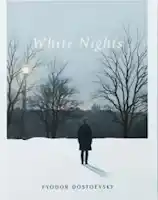
This isn’t a story about romance or heartbreak, really. It’s about people who exist between worlds—between reality and imagination, between action and paralysis, between speech and silence. And maybe some of us recognize ourselves in that in-between space more than we’d like to admit.
A short classic that lingers on identity, solitude, and lives lived between reality and imagination.
Affiliate link. I may earn a small commission at no extra cost to you.