Skip to content

Bookboochi

Books. Thoughts. Stories that linger.

Book Reviews by Characters

What If Gandhari Reviewed the Mahabharata

Contents
  1. A Story Worth Reading
  2. Who Gets to Tell the Truth
  3. The Day They Took Me From Gandhara
  4. My Brother, Their Villain
  5. A Blind King's Silence
  6. My Sons Were Not Symbols
  7. Read With Your Eyes Open
  8. A Story Worth Reading
  9. Who Gets to Tell the Truth
  10. The Day They Took Me From Gandhara
  11. My Brother, Their Villain
  12. A Blind King's Silence
  13. My Sons Were Not Symbols
  14. Read With Your Eyes Open

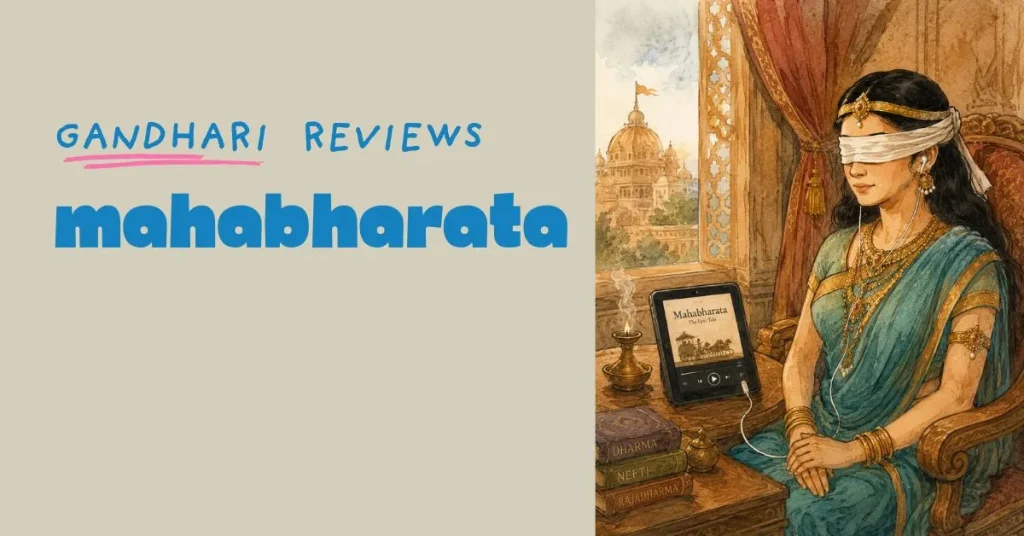
I have read the Mahabharata as a book about my own life, and I am struck by how neatly the victors have arranged the story. Every page is well written. Every scene is carefully placed. And yet, somewhere between the beautiful lines, I keep losing myself. I keep looking for the woman who lived through all of it, and I find only the shapes other people made of her.

You may have read this book for the war, or the wisdom, or the drama. I read it as the woman who buried her sons after it was over. So let me walk you through it the way I see it, not the way it was written for you.

A Story Worth Reading

I will not pretend the book is dull. It is not. There is real skill in how it is put together. A grandfather takes a vow so strange and so total that it changes the shape of a whole family for generations. A queen is won in an archery contest and then nearly lost in a game of dice. Brothers plot in whispers behind doors while a blind king sits and says nothing. Gods step in when the story needs them to, and armies gather on a field that becomes sacred simply because so many died there.

If you want a tale full of turns you cannot guess, this book gives you that. The dice game alone would keep anyone reading late into the night. A woman is dragged into a hall full of men who call themselves honorable, and every one of them finds a reason to stay seated. You will not forget that scene once you have read it.

But here is what I want you to notice. A story can be gripping and still be unfair. The two things are not opposites. In fact, the more gripping a story is, the less most readers stop to ask who is being praised and who is being blamed, because they are too busy turning the page to find out what happens next. I am asking you to slow down. Enjoy the drama if you like, but do not let the drama do your thinking for you.

Who Gets to Tell the Truth

Here is something worth sitting with. History is not simply what happened. History is what got written down, and what got written down was almost always written by the side that survived, and mostly by the side that won.

Think about how many hands this story passed through before it reached you. Different tellers, in different courts, at different times, each shaping it a little more to fit the ruler they served or the values their age wanted to see praised. A version told to please one king would look different from a version told to please another. A poet paid by the winning family is not going to write a line that makes his patrons look small. This is simply how storytelling near power has always worked.

So when a book tells you plainly who was righteous and who was wicked, ask yourself who had the pen. Ask who was in the room when the story was first shaped, and who was not. I am not asking you to throw away the book. I am asking you to read it the way you would read a letter written by someone who has already decided who the villain is before the story even begins.

The Day They Took Me From Gandhara

The book may describe my marriage as a powerful alliance for the Kuru family, or as an act of Kuru bravery and daring. Read it again slowly and you will see how comfortably that language sits with the men who arranged it, and how little room it leaves for me.

What actually happened is simpler and harder to dress up. I was taken from my mother’s house. I was not asked what I wanted. My brothers agreed to send me away because a powerful family demanded it, and refusing a powerful family carries its own dangers. I left behind my language, my gods as I knew them, my river, my own name as my family called it, and I was given a new house to belong to whether I wished to or not.

Call it an alliance if that word makes the story feel grand. I call it a girl being moved like a piece on a board, and I think it is worth telling you plainly, in case no one else has, that a marriage arranged this way does not feel like bravery to the girl inside it. It feels like a door closing behind you while everyone outside congratulates each other.

My Brother, Their Villain

Of everyone in this story, my brother Shakuni carries the heaviest name. Ask most readers of this book who ruined the family, and his name comes up first, sometimes before anyone else’s.

I ask you to look again. Shakuni came to that court as my brother. He came because his sister had been sent away to a strange land and a strange family, and he wanted to stand near her, to watch over her, to be one familiar face in a house full of strangers. That is not the beginning of a villain’s story. That is the beginning of a brother’s story.

But a court is not always kind to someone who arrives from elsewhere. An outsider is easy to blame because no one has to feel responsible for him, and no one has to admit that the trouble came from inside their own walls. When a whole dynasty begins to rot from decisions made by its own princes, its own king, its own advisors, it is far more comfortable to point at the man who was never quite one of them and say, there, that is where it started. It is a convenient kind of blame. It costs the family nothing. I watched it happen to my own brother, and I have never believed it was the whole truth.

A Blind King’s Silence

I will not pretend my husband’s life was easy. Dhritarashtra was born without sight in a world that measured a man’s worth by his ability to rule and to fight, and he was passed over for the throne because of it, then handed it later almost as an afterthought. I understand where his fear came from. I understand the shame that followed him, and the hunger to make sure his own sons were never made to feel small the way he had been.

But understanding where someone’s wound comes from is not the same as excusing what they did with it. He was a husband who often said nothing when something needed to be said. He was a king who let wrong things happen in his own hall because stopping them was harder than staying silent. He was a father who could not, or would not, tell his own children no, even when saying no was the one thing that might have saved them.

Suffering explains a man. It does not excuse him. I loved him, and I lived beside him for my whole life, and still I will tell you plainly that his silence cost more than his blindness ever did.

My Sons Were Not Symbols

I gave birth to a hundred sons, and I watched this book turn them, one by one, into warnings. Read enough pages and you would think they were born simply to prove a lesson about greed or pride, as if a child comes into the world already written as a moral for someone else’s story.

They were not simple men, and I will not stand here and tell you they were without fault. They made choices I grieved over while they were still alive to make them. But so did the men on the other side of that war. Every family in this story schemed, every family made choices born of pride and fear, and yet only one side walks away from these pages remembered with complexity, with grace, even with glory, while the other side is remembered mainly as a lesson in what not to become.

This is what happens when the losing side does not get to shape how it is remembered. My sons are gone, and they cannot speak for themselves in these pages, so allow me to say what I can on their behalf. They were flawed men who lived and died as flawed men do, and they did not deserve to become nothing more than a warning printed at the end of someone else’s happy ending.

Read With Your Eyes Open

I am not asking you to close this book. It is a rich story, full of things worth turning over in your mind for years, and I would not take that pleasure from you even if I could. Read the dice game. Read the war. Let the vows and the reveals and the divine moments carry you along, the way stories are meant to carry a reader.

But carry one habit with you as you read. When you are told who was noble, stop for a moment and ask who had the power to preserve that version of events. When you are told who was monstrous, ask who benefited from the story needing a monster in the first place. Every grand tale of victory needs someone to have lost, and it is always easier on the conscience if the losing side deserved it.

I lived this story before it became a book. I watched my brother turned into a villain, my husband’s silence turned into fate, my sons turned into a warning, and my own removal from my home turned into a proud alliance. None of it was quite the truth, though all of it was written well enough to be believed.

So enjoy the book. Just remember, as you read, that I am still here, watching you read it, wondering if this time someone might ask the question no one thought to ask before.

I have read the Mahabharata as a book about my own life, and I am struck by how neatly the victors have arranged the story. Every page is well written. Every scene is carefully placed. And yet, somewhere between the beautiful lines, I keep losing myself. I keep looking for the woman who lived through all of it, and I find only the shapes other people made of her.

You may have read this book for the war, or the wisdom, or the drama. I read it as the woman who buried her sons after it was over. So let me walk you through it the way I see it, not the way it was written for you.

A Story Worth Reading

I will not pretend the book is dull. It is not. There is real skill in how it is put together. A grandfather takes a vow so strange and so total that it changes the shape of a whole family for generations. A queen is won in an archery contest and then nearly lost in a game of dice. Brothers plot in whispers behind doors while a blind king sits and says nothing. Gods step in when the story needs them to, and armies gather on a field that becomes sacred simply because so many died there.

If you want a tale full of turns you cannot guess, this book gives you that. The dice game alone would keep anyone reading late into the night. A woman is dragged into a hall full of men who call themselves honorable, and every one of them finds a reason to stay seated. You will not forget that scene once you have read it.

But here is what I want you to notice. A story can be gripping and still be unfair. The two things are not opposites. In fact, the more gripping a story is, the less most readers stop to ask who is being praised and who is being blamed, because they are too busy turning the page to find out what happens next. I am asking you to slow down. Enjoy the drama if you like, but do not let the drama do your thinking for you.

Who Gets to Tell the Truth

Here is something worth sitting with. History is not simply what happened. History is what got written down, and what got written down was almost always written by the side that survived, and mostly by the side that won.

Think about how many hands this story passed through before it reached you. Different tellers, in different courts, at different times, each shaping it a little more to fit the ruler they served or the values their age wanted to see praised. A version told to please one king would look different from a version told to please another. A poet paid by the winning family is not going to write a line that makes his patrons look small. This is simply how storytelling near power has always worked.

So when a book tells you plainly who was righteous and who was wicked, ask yourself who had the pen. Ask who was in the room when the story was first shaped, and who was not. I am not asking you to throw away the book. I am asking you to read it the way you would read a letter written by someone who has already decided who the villain is before the story even begins.

The Day They Took Me From Gandhara

The book may describe my marriage as a powerful alliance for the Kuru family, or as an act of Kuru bravery and daring. Read it again slowly and you will see how comfortably that language sits with the men who arranged it, and how little room it leaves for me.

What actually happened is simpler and harder to dress up. I was taken from my mother’s house. I was not asked what I wanted. My brothers agreed to send me away because a powerful family demanded it, and refusing a powerful family carries its own dangers. I left behind my language, my gods as I knew them, my river, my own name as my family called it, and I was given a new house to belong to whether I wished to or not.

Call it an alliance if that word makes the story feel grand. I call it a girl being moved like a piece on a board, and I think it is worth telling you plainly, in case no one else has, that a marriage arranged this way does not feel like bravery to the girl inside it. It feels like a door closing behind you while everyone outside congratulates each other.

My Brother, Their Villain

Of everyone in this story, my brother Shakuni carries the heaviest name. Ask most readers of this book who ruined the family, and his name comes up first, sometimes before anyone else’s.

I ask you to look again. Shakuni came to that court as my brother. He came because his sister had been sent away to a strange land and a strange family, and he wanted to stand near her, to watch over her, to be one familiar face in a house full of strangers. That is not the beginning of a villain’s story. That is the beginning of a brother’s story.

But a court is not always kind to someone who arrives from elsewhere. An outsider is easy to blame because no one has to feel responsible for him, and no one has to admit that the trouble came from inside their own walls. When a whole dynasty begins to rot from decisions made by its own princes, its own king, its own advisors, it is far more comfortable to point at the man who was never quite one of them and say, there, that is where it started. It is a convenient kind of blame. It costs the family nothing. I watched it happen to my own brother, and I have never believed it was the whole truth.

A Blind King’s Silence

I will not pretend my husband’s life was easy. Dhritarashtra was born without sight in a world that measured a man’s worth by his ability to rule and to fight, and he was passed over for the throne because of it, then handed it later almost as an afterthought. I understand where his fear came from. I understand the shame that followed him, and the hunger to make sure his own sons were never made to feel small the way he had been.

But understanding where someone’s wound comes from is not the same as excusing what they did with it. He was a husband who often said nothing when something needed to be said. He was a king who let wrong things happen in his own hall because stopping them was harder than staying silent. He was a father who could not, or would not, tell his own children no, even when saying no was the one thing that might have saved them.

Suffering explains a man. It does not excuse him. I loved him, and I lived beside him for my whole life, and still I will tell you plainly that his silence cost more than his blindness ever did.

My Sons Were Not Symbols

I gave birth to a hundred sons, and I watched this book turn them, one by one, into warnings. Read enough pages and you would think they were born simply to prove a lesson about greed or pride, as if a child comes into the world already written as a moral for someone else’s story.

They were not simple men, and I will not stand here and tell you they were without fault. They made choices I grieved over while they were still alive to make them. But so did the men on the other side of that war. Every family in this story schemed, every family made choices born of pride and fear, and yet only one side walks away from these pages remembered with complexity, with grace, even with glory, while the other side is remembered mainly as a lesson in what not to become.

This is what happens when the losing side does not get to shape how it is remembered. My sons are gone, and they cannot speak for themselves in these pages, so allow me to say what I can on their behalf. They were flawed men who lived and died as flawed men do, and they did not deserve to become nothing more than a warning printed at the end of someone else’s happy ending.

Read With Your Eyes Open

I am not asking you to close this book. It is a rich story, full of things worth turning over in your mind for years, and I would not take that pleasure from you even if I could. Read the dice game. Read the war. Let the vows and the reveals and the divine moments carry you along, the way stories are meant to carry a reader.

But carry one habit with you as you read. When you are told who was noble, stop for a moment and ask who had the power to preserve that version of events. When you are told who was monstrous, ask who benefited from the story needing a monster in the first place. Every grand tale of victory needs someone to have lost, and it is always easier on the conscience if the losing side deserved it.

I lived this story before it became a book. I watched my brother turned into a villain, my husband’s silence turned into fate, my sons turned into a warning, and my own removal from my home turned into a proud alliance. None of it was quite the truth, though all of it was written well enough to be believed.

So enjoy the book. Just remember, as you read, that I am still here, watching you read it, wondering if this time someone might ask the question no one thought to ask before.

Leave a comment

Your email address will not be published. Required fields are marked *