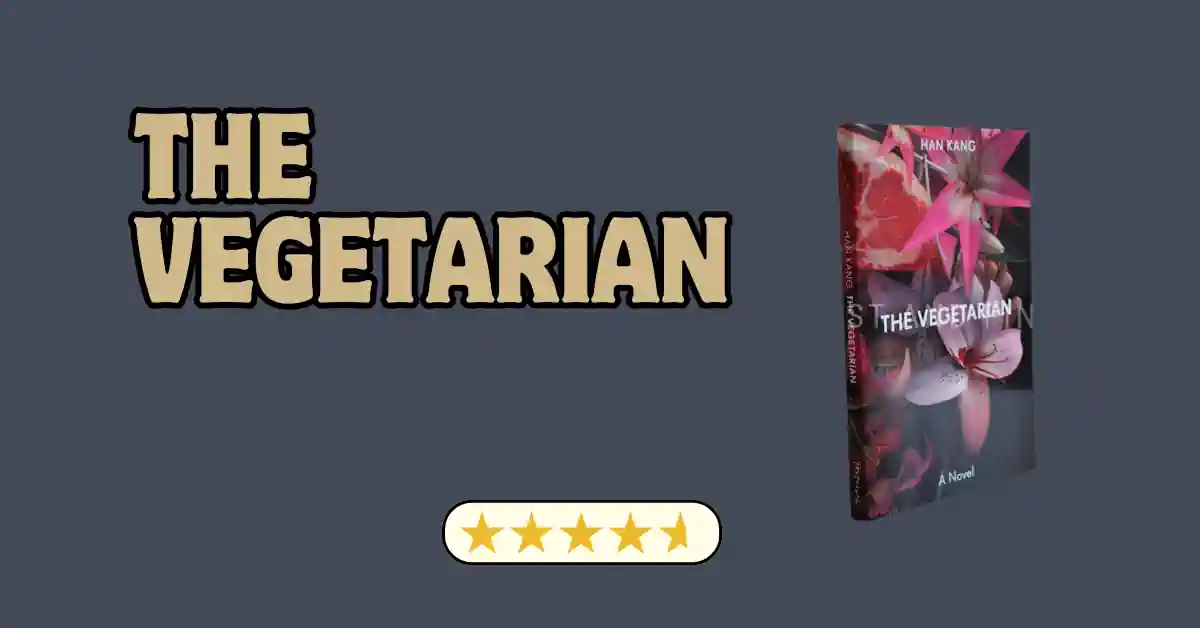
The Vegetarian by Han Kang: A Book Full of Symbols, Silence, and Quiet Screams
Most books give you a story with a beginning, middle, and end. They wrap things up nicely. They explain what everything means. They tell you how to feel.
The Vegetarian by Han Kang doesn’t do any of that.
Instead, it gives you something that sits in your chest like a weight. Something that makes you uncomfortable. Something that stays with you for days, weeks, maybe longer, refusing to let go.
And the strangest part? You might not even be able to explain why it affected you so much.
A Simple Decision That Changes Everything
On the surface, this book seems simple. Almost too simple.
A woman named Yeong-hye wakes up one day and decides to stop eating meat. That’s it. That’s the starting point.
You might think: Okay, so she becomes a vegetarian. So what? Lots of people are vegetarians. What’s the big deal?
But this isn’t really a book about food. It’s not about diets or health or animal rights or any of that.
It’s about what happens when a woman says “no” in a world that’s been built on her saying “yes.”
It’s about what happens when someone refuses to be what everyone expects them to be.
It’s about the violence—physical, emotional, psychological—that comes down on people who won’t play along with the rules everyone else takes for granted.
And it’s about the different ways people break when they can’t take it anymore.
The Book That Refuses to Explain Itself
Here’s something you should know before you read The Vegetarian: it’s not going to hold your hand. It’s not going to explain what everything means. It’s not going to tell you whether you should feel sorry for Yeong-hye or whether she’s lost her mind or whether what happens to her is tragic or inevitable or somehow both.
The book shows you things. Quietly. Symbolically. Sometimes disturbingly.
And then it leaves you to figure out what it all means.
Different people will read this book and come away with completely different interpretations. And that’s not a bug—it’s the whole point.
Some people will see it as a story about mental illness. Others will see it as a feminist text about bodily autonomy. Some will read it as a philosophical exploration of what it means to be human. Others will see it as a critique of Korean culture, or family dynamics, or the medical system, or society’s treatment of women.
And here’s the thing—they’ll all be right. Because the book contains all of those things. It’s layered. It’s complex. It doesn’t give you easy answers because life doesn’t give you easy answers.
What you get out of it will depend on who you are, what you’ve been through, what you’re afraid of, what you’ve survived.
When “No” Becomes a Crime
So Yeong-hye stops eating meat. Just that. Nothing dramatic. Nothing violent. She simply decides she doesn’t want meat in her body anymore.
And the world around her loses its mind.
Her husband—the first person whose perspective we get—is annoyed. Not concerned. Not curious. Just irritated that his wife is no longer “normal.” He liked her specifically because she was boring, unremarkable, easy to live with. Now she’s causing problems. Now she’s making his life difficult. Now she’s embarrassing him in front of other people.
He doesn’t ask her why. He doesn’t try to understand. He just wants her to go back to being the person he married—the quiet, obedient woman who never caused any trouble.
Then her family gets involved. And they’re not just annoyed—they’re outraged. Furious. How dare she refuse to eat meat? How dare she go against tradition? How dare she make herself different from everyone else?
They don’t see her choice as a personal decision about her own body. They see it as a betrayal. An insult. An attack on the family itself.
They try everything to force her to eat. They yell at her. They plead with her. They try to guilt her. They threaten her.
And when none of that works, they get violent.
Her own father shoves meat into her mouth, trying to force her to swallow it. When she spits it out, he slaps her. Hard. In front of the whole family.
And here’s the thing that makes it even worse—nobody stops him. Nobody says “Wait, this is too far.” Nobody defends her.
Because in their minds, she’s the one who’s wrong. She’s the one who started this by refusing to obey. She’s the one who brought this on herself.
The violence isn’t seen as violence. It’s seen as necessary correction. As tough love. As what you have to do to bring someone back in line.
And when that doesn’t work either, when she still refuses to eat meat, the medical system steps in. Doctors and psychiatrists who want to diagnose her, medicate her, fix her.
But here’s what nobody does: Nobody listens to her.
Nobody asks her what the meat represents to her. Nobody tries to understand what she’s trying to escape from. Nobody treats her refusal as valid, as meaningful, as something that matters.
They all just want her to go back to normal. Back to being the woman who doesn’t cause problems. Back to being invisible.
The Woman Who Never Gets to Tell Her Own Story
The book is divided into three parts. Three sections, each told from a different person’s perspective.
First, we hear from her husband. Then from her brother-in-law. Then from her sister.
Notice who’s missing? Yeong-hye herself.
She never gets to narrate her own story. We never get inside her head fully. We only see her through other people’s eyes—people who don’t understand her, people who want something from her, people who are frustrated by her, afraid of her, obsessed with her.
We get glimpses of her thoughts. Fragments. Dreams she describes. Brief moments where she speaks. But we never get the full picture from her point of view.
And that’s devastating. Because it mirrors what’s happening in the story itself.
Everyone is talking about Yeong-hye. Everyone has opinions about her. Everyone is trying to control her, fix her, understand her, use her.
But nobody is actually listening to her. Nobody is letting her speak for herself.
Even the book itself doesn’t give her that space. And maybe that’s the point. Maybe that’s what makes it so powerful and so painful.
We’re put in the same position as the other characters—trying to figure her out from the outside, watching her slip further and further away, unable to reach her or understand her fully.
It’s frustrating. It’s heartbreaking. And it feels horribly, uncomfortably real.
Because how many women’s stories have been told this way? Through other people’s perspectives? Filtered through what others think about them rather than what they think about themselves?
How many women have been silenced while everyone around them talks and talks and talks about what they should do, who they should be, how they should live?
Becoming a Canvas, Becoming Nothing
The second part of the book is where things get even stranger and more disturbing.
Yeong-hye’s brother-in-law is an artist. A video artist. And he becomes obsessed with her.
He starts imagining her body covered in flowers. Painted. Decorated. Transformed into living art.
At first it’s just a fantasy. But then he approaches her about it. And she agrees.
He paints her body—flowers, vines, leaves. He turns her skin into a canvas. And then he films her. Makes art out of her.
And here’s where it gets complicated: Is she being exploited? Or is this somehow her choice?
The book doesn’t give you an easy answer. Because maybe it’s both. Maybe those things aren’t mutually exclusive.
On one hand, her brother-in-law is clearly using her. He’s obsessed with her in a way that’s not healthy. He’s not really seeing her as a person—he’s seeing her as an object, a blank surface he can project his artistic vision onto.
But on the other hand, Yeong-hye seems to want this. She agrees to it. She participates willingly. She even seems peaceful during the process.
And maybe that’s because, in a twisted way, this is her reclaiming her body. By turning herself into a surface—into nothing but painted skin—she’s erasing herself. She’s becoming disconnected from her body, from her identity, from everything people expect from her.
She’s not a wife anymore. Not a daughter. Not a woman with duties and responsibilities and expectations weighing her down.
She’s just a canvas. A surface. A thing to be looked at but not touched in the ways she’s been touched before. Not possessed. Not controlled.
It’s disturbing. It’s unsettling. And it’s also, in its own strange way, a form of escape.
The Dream of Becoming a Tree
And then things go even further.
Yeong-hye starts believing she’s becoming a tree.
She stops eating almost entirely. She stands on her head for hours, trying to make the blood flow to her head like sap. She wants to photosynthesize. She wants roots instead of legs.
At first, it seems like pure delusion. Like she’s completely lost touch with reality. Like she’s gone mad.
And maybe she has, in the traditional sense. Maybe by any clinical definition, this is a mental breakdown.
But if you look deeper—if you really think about what she’s doing—it starts to make a different kind of sense.
Trees don’t speak. They don’t have to explain themselves. They don’t have to say yes or no to anyone. They don’t have desires that need to be satisfied or duties that need to be fulfilled. They don’t have gender or sexuality or any of the things that make someone vulnerable to control.
They just exist. Silently. Peacefully. Growing at their own pace. Needing nothing from anyone.
Nobody punishes a tree for being what it is. Nobody forces a tree to be something else. Nobody shoves things into a tree’s mouth or slaps it for disobedience or locks it up for refusing to comply.
A tree can’t be violated. Can’t be possessed. Can’t be made to do anything it doesn’t want to do.
For Yeong-hye, becoming a tree isn’t madness. It’s the only form of existence that feels safe.
It’s the only way she can imagine living without constantly being hurt, controlled, used, or violated.
She’s not losing her mind. She’s opting out of the only game she knows—the game where women’s bodies and lives belong to everyone except themselves.
She’s choosing a form of life where there’s no gender, no duty, no expectation, no violence. Just stillness. Just being. Just existing without having to explain or justify or perform or comply.
And when you think about it that way, it’s not crazy at all. It’s heartbreaking. It’s a survival strategy. It’s the only escape she can imagine that doesn’t involve dying.
Though, of course, this kind of escape might be a slow form of death anyway. Which is maybe the point. Maybe there is no real escape. Maybe that’s what the book is telling us.
The Dog and the Warning
There’s a moment in this book that I still can’t shake. It happens early on, during a family dinner.
Yeong-hye’s father has a dog. The dog bites Yeong-hye at some point—we don’t get the full context, but it happens.
And what does her father do? He ties the dog to a motorcycle. And he drags it. He drags this living creature behind a vehicle until it’s dead.
It’s one of the most brutal, shocking moments in the book. It’s described briefly, matter-of-factly, almost in passing. But it hits like a punch to the stomach.
And it’s not just horrific—it’s symbolic.
The dog was punished for being disobedient. For biting. For saying “no” in the only way a dog can.
And it was killed for it.
Later, Yeong-hye is punished for doing the exact same thing. For saying “no.” For refusing to obey. For biting back, in her own quiet way.
The dog is a warning. This is what happens when you don’t comply. This is what happens when you resist. This is the violence that waits for anyone who steps out of line.
And the worst part? The father doesn’t see anything wrong with what he did. Nobody in the family seems particularly disturbed by it. It’s just… what you do when something doesn’t behave.
That casual brutality, that acceptance of violence as a normal response to disobedience—it runs through the whole book. It’s in how the husband treats his wife. It’s in how the family treats Yeong-hye. It’s in how society treats women who don’t fit the mold.
The dog’s death isn’t random. It’s a preview. A symbol. A promise of what’s coming.
The Sister Who’s Quietly Drowning
But here’s the thing: The real heartbreak of this book isn’t Yeong-hye.
It’s her sister, In-hye.
In-hye is the “normal” one. The functional one. The one who does everything right.
She runs a business. She raises a child. She takes care of her family. She keeps everything together. She doesn’t make waves. She doesn’t cause problems. She’s responsible. Reliable. Stable.
Society looks at In-hye and sees success. Sees a woman who has her life together. Sees someone who’s doing what she’s supposed to do.
But inside, she’s breaking apart.
She’s exhausted. She’s lonely. She’s drowning under the weight of all the responsibilities she carries. She’s watching her sister disappear and she can’t save her and she’s also watching her own life slip away and she doesn’t know how to stop it.
And there’s this moment—this beautiful, devastating moment—where In-hye thinks about birds.
She doesn’t want to be a bird in some romantic, poetic sense. She’s not thinking about freedom or beauty or any of that.
She just wants to be something that doesn’t carry anything. Something that doesn’t have to take care of anyone. Something that can just fly away and leave everything behind.
Birds don’t have jobs. They don’t have children depending on them. They don’t have husbands or families or businesses or duties. They don’t have to worry about everyone else before they worry about themselves.
They just fly. They’re weightless. They’re free.
And In-hye is so, so tired of being heavy. Of carrying everything. Of being the strong one, the responsible one, the one who holds it all together.
Her wish to be a bird isn’t whimsical. It’s not about wanting wings.
It’s desperation. It’s exhaustion. It’s a longing for release that’s so deep and so painful that it rivals anything her sister is going through.
And here’s what makes it even worse: Nobody sees it. Nobody notices. Nobody asks In-hye if she’s okay because she looks okay. She functions. She keeps going. So everyone assumes she’s fine.
But she’s not fine. She’s drowning just as much as Yeong-hye is. The difference is that Yeong-hye’s drowning is visible, dramatic, impossible to ignore. In-hye’s drowning is quiet, invisible, socially acceptable.
One sister breaks loudly. The other breaks silently.
One gets locked up. The other walks free.
But both are trying to disappear.
A Story That Means Different Things to Different People
The thing about The Vegetarian is that everyone who reads it will see something different.
Some people will read it as a feminist text—a story about what happens to women when they refuse to comply with societal expectations. About bodily autonomy and the violence that comes down on women who claim ownership of their own bodies.
Some will read it as a story about mental illness—about a woman’s descent into psychosis and the failure of everyone around her to help her in time.
Some will see it as a critique of Korean culture specifically—the rigid family structures, the emphasis on obedience and conformity, the way individualism is crushed in favor of collective harmony.
Some will read it as a philosophical exploration—what does it mean to be human? What’s the difference between existing and living? Can someone choose to stop being human? Should they be stopped if they try?
And all of those readings are valid. The book contains all of those things. It’s rich enough, complex enough, open enough to support multiple interpretations.
For me, personally, it was a story about two women breaking under different kinds of pressure. About the visible and invisible ways women are crushed by the expectations placed on them. About the different strategies people use to escape when they can’t take it anymore.
One woman stops eating and tries to become a tree. Another woman keeps functioning but dreams of flying away.
One is obviously broken. The other seems fine.
But both are reaching for the same thing: a way out. A form of existence where they don’t have to be what everyone else needs them to be.
And the tragedy is that neither of them gets it. Not really. Not in any way that brings peace or happiness or even relief.
What to Expect When You Read It
If you’re thinking about reading The Vegetarian, here’s what you should know:
This is not an easy book. It’s not comfortable. It’s not pleasant. It’s disturbing and strange and it will probably make you feel things you don’t want to feel.
If you’re looking for a traditional plot with clear motivations and satisfying resolutions, you might get frustrated. The book doesn’t work that way. It’s more like poetry than prose in some ways—symbolic, elliptical, open to interpretation.
Things happen without full explanations. Characters do things without spelling out exactly why. The narrative skips ahead without showing you everything in between.
You have to sit with the ambiguity. You have to be okay with not understanding everything right away. You have to let the book work on you slowly, let the images and symbols sink in, let the meaning reveal itself over time.
But if you’re willing to engage with it on those terms—if you’re willing to sit with the discomfort and the confusion and the questions without easy answers—then you’ll find something incredibly powerful.
You’ll find a book that stays with you. That haunts you. That makes you think about things you’ve never thought about before or see things in a different light.
You’ll find yourself thinking about it days later. Weeks later. Suddenly understanding something you didn’t understand when you first read it. Seeing a new layer you missed the first time.
And you’ll probably want to talk about it. Because it’s the kind of book that demands discussion. That makes you want to ask other people: “What did you think this meant? How did you interpret that scene? Did you see it the same way I did?”
The Layers Keep Revealing Themselves
One of the most beautiful and frustrating things about The Vegetarian is that it keeps giving you more the longer you think about it.
The first time you read it, you might focus on the surface story—a woman stops eating meat and things spiral out of control.
But then you think about it more and you start seeing the symbols. The meat representing violence, consumption, complicity. The plants and trees representing escape from human society and its demands. The Mongolian mark on Yeong-hye’s body—that birthmark that her husband hates—representing the parts of ourselves we’re taught to hide or be ashamed of.
And then you think about it even more and you start seeing the deeper patterns. The way every man in the book sees Yeong-hye as an object—her husband sees her as a convenience, her brother-in-law sees her as art, the doctors see her as a problem to solve. The way women are expected to sacrifice themselves—In-hye for her family, Yeong-hye’s mother for her husband, Yeong-hye herself for everyone else’s comfort.
And then you start connecting it to the world around you. You start noticing how often women are expected to make themselves smaller, quieter, more convenient. How saying “no” is treated as aggression. How the most extreme forms of self-denial (dieting, cosmetic surgery, endless self-improvement) are praised while the slightly-less-acceptable forms (like Yeong-hye’s vegetarianism) are punished.
The book keeps unfolding. Keeps revealing new layers. Keeps making you see things you didn’t see before.
And that’s what makes it special. It’s not just a book you read once and forget. It’s a book that gets under your skin and stays there. That changes how you see things. That makes you notice patterns you never noticed before.
Why This Book Matters

In the end, The Vegetarian matters because it refuses to offer comfort. It refuses to tell you everything will be okay. It refuses to wrap things up neatly or provide easy answers.
It shows you people breaking—in different ways, for different reasons, with different results. And it doesn’t tell you who to feel sorry for or who’s right or who’s wrong.
It just shows you what happens. What can happen. What does happen, to women especially, when the pressure becomes too much.
And it asks you to sit with that. To really look at it. To not turn away even when it gets uncomfortable.
Is it a perfect book? That’s not really the right question. It’s not trying to be perfect. It’s trying to be true. And disturbing. And unforgettable.
It’s trying to show you something about control and autonomy and violence and escape that you can’t unsee once you’ve seen it.
It’s trying to make you think about bodies—who owns them, who controls them, what it means when someone tries to reclaim theirs in the only way they can imagine.
It’s trying to make you think about the different ways people break and the different ways society responds depending on who’s breaking and how visibly.
And it succeeds. God, does it succeed.
This is not a book that will make you happy. But it will make you think. It will make you feel. It will stay with you long after you’ve turned the last page.
You won’t forget Yeong-hye standing on her head, trying to become a tree. You won’t forget In-hye staring out a window, wishing she could fly away. You won’t forget that dog tied to a motorcycle, and what it meant, and what it promised.
You won’t forget the silence at the center of the book—Yeong-hye’s silence, the things she can’t or won’t say, the voice she’s never allowed to have.
And maybe, just maybe, you’ll start noticing the silences around you. The people who are breaking quietly while everyone else walks past. The ones who are slowly disappearing while trying to look normal. The ones who are desperately trying to escape in the only ways they can imagine.
That’s what this book does. It makes you see. It makes you notice. It makes you think.
And it doesn’t let go.
Even now, writing this, I can feel it pulling at me. Making me think about what it means to have a body in a world that thinks it owns you. What it means to say “no” when everyone expects “yes.” What it means to break, and how many different ways there are to break, and how many of them we never notice because we’re not looking closely enough.
The Vegetarian is not an easy book. But it’s an important one. A necessary one. A powerful one.
Read it. Sit with it. Let it disturb you. Let it haunt you.
And then, maybe, talk about it. Because these are conversations we need to have. About bodies and control and freedom and escape and the thousand different ways we hurt each other without even realizing we’re doing it.
This book starts those conversations. And that’s why it matters.
Want to read The Vegetarian and step into a world where quiet resistance becomes deeply unsettling?
Disclosure: This is an Amazon affiliate link. I may earn a small commission at no extra cost to you.